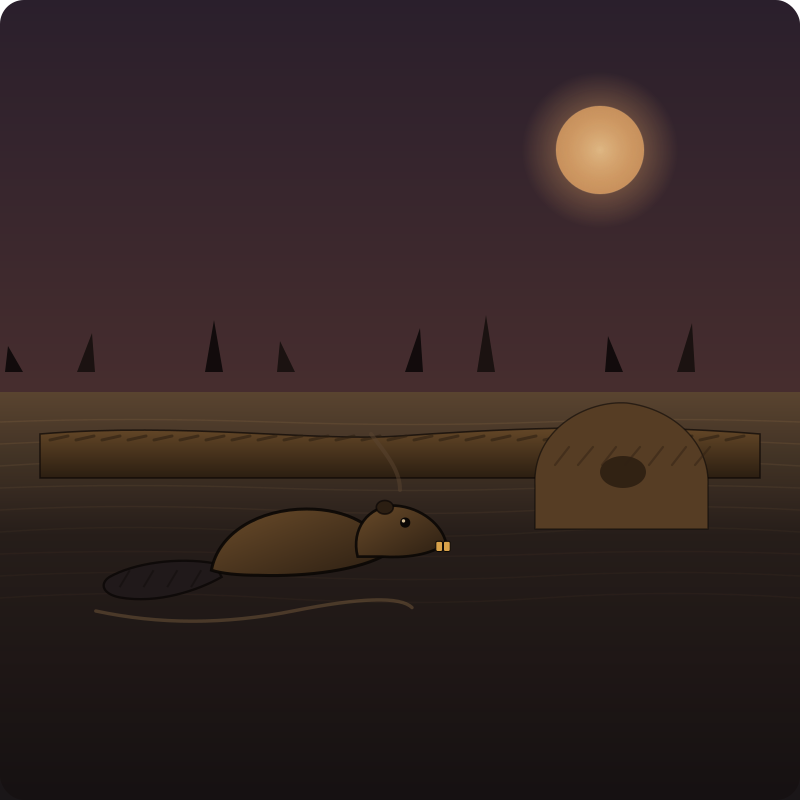
Meet the Beaver
A stocky, near-sighted rodent that redraws a valley's water without asking anyone's permission.
A stocky, dark-furred rodent of ponds and slow rivers, built low and thick through the shoulders, with a flat scaled tail and teeth that never stop growing.
Everything this reading says about you is grounded in what the Beaver actually is: an animal that fells trees with continuously growing incisors, engineers a dam to the exact speed of the current fighting it, builds a lodge meant to last generations, and works largely unseen, at dusk and through the night. This chapter is that foundation. The rest of the page draws its meaning from these real traits.
The dam was never really about the wood. It was about what the wood was holding back.
6 traits below
01of six
The self-sharpening incisors
A beaver's four front incisors are coated in iron-fortified, orange enamel and grow continuously through its life, wearing at an angle that keeps them permanently sharp enough to fell a tree.
You keep the one tool you actually need in constant working order. You do not wait for a project to demand it; the edge is already there when the moment calls for it.
02of six
The dam built to the current
Beavers build dams straight in slow water and curved against fast water, adjusting the structure's shape to the exact force of the current it has to hold back.
You change your method without changing your goal. Whatever is pushing against you decides the shape of the response, not whether you respond at all.
03of six
The lodge, added onto for years
A beaver lodge is a dome of packed sticks and mud with a dry chamber above the waterline and an entrance reachable only underwater, and a colony will keep expanding the same lodge across several generations.
What you build is meant to be added onto, not replaced. The way in is not obvious from outside, and the room that matters is the one that stays dry no matter how high the water gets.
04of six
The paddle tail's second job
The flat, scaled tail serves as a rudder and paddle in the water, a fat reserve for lean months, and an alarm, slapped hard against the surface, to warn the rest of the colony of danger.
You carry your own reserve quietly and warn the people close to you loudly. The alert is not for you. By the time you sound it, you have already decided you can absorb the hit yourself.
05of six
The yearling apprentice
Beaver pairs are largely monogamous, and kits stay with the family for about two years, with the older yearlings helping raise the newest litter and repair the dam before dispersing to build their own.
You were taught the work by watching it get done, not by being told about it, and you expect the same from whoever eventually stands where you stood. Trust, for you, is built the same slow way as everything else.
06of six
The cache under the ice
Before winter, a beaver colony submerges a pile of branches near the lodge entrance, a cache reachable from underwater once the pond freezes over, so the family can feed without ever breaking the surface.
You prepare for the isolation before it arrives. You would rather stock the winter early than ask, mid-storm, for someone to bring you something.