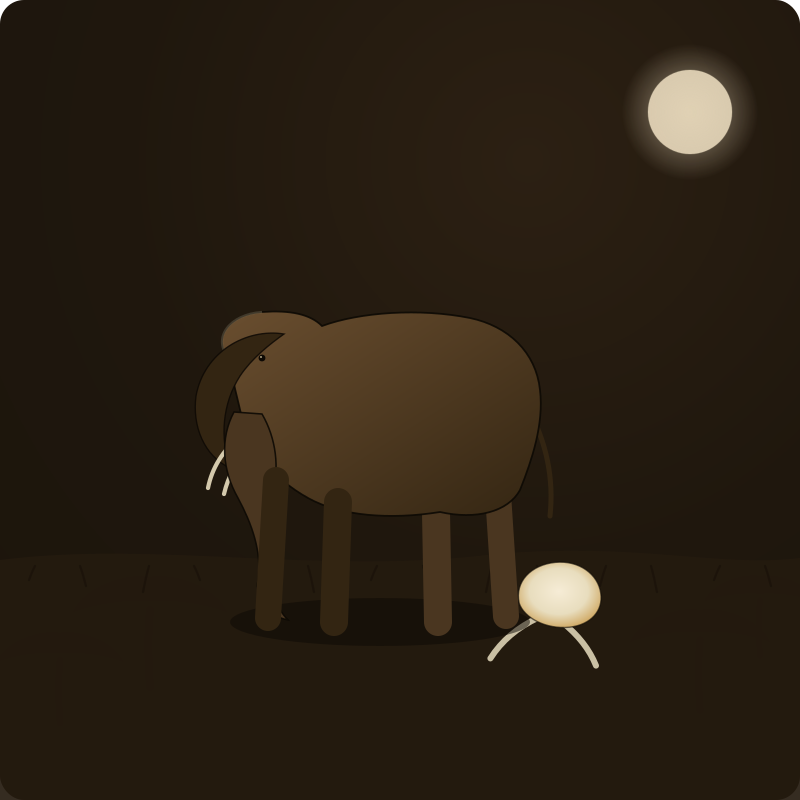
Meet the Asian Elephant
A body built to labor and remember, that only lets the weight show in a real crisis
The largest land animal in Asia, matriarch-led and slow-growing, moving through forest and grassland on a memory that spans decades.
Everything this reading says about you is grounded in what the Asian Elephant actually is: a creature that labors nearly around the clock, communicates through sound too low to hear, and carries the specific memory of water, food, and its own dead across a lifetime that can run sixty years. This chapter is that foundation. The rest of the page draws its meaning from these real traits.
The memory was never the burden. Never being allowed to lay it down for a moment is.
6 traits below
01of six
The visit to the bones
Elephants have been documented returning to the remains of dead herd members years after death, touching the skull and tusks with their trunks; one study recorded a family returning to a matriarch's skeleton after twenty-two months, standing in silence before moving on.
A loss does not get processed once and filed away. You go back to it, on your own schedule, long after everyone else has decided it is time to move on.
02of six
The single finger
Unlike the African elephant's two fingerlike projections, the Asian elephant's trunk tip has one dorsal finger and a lower lip it uses to wrap rather than pinch, an anatomical difference tied to how each species actually handles what it picks up.
Your instinct is to hold what matters whole, wrapped and gathered in, rather than pinched at arm's length. You enclose the thing you're carrying instead of just gripping it.
03of six
The rumble underfoot
Asian elephants produce infrasonic calls as low as 14 to 24 hertz, below human hearing, which travel through the ground as well as the air; elephants are thought to detect the seismic component through sensitive receptors in their feet and trunk.
You register what is wrong in a room before it is spoken. The warning arrives as a feeling in the body, not a sentence, and you have felt trouble coming through the floor more than once.
04of six
The gland that stays dry
In female Asian elephants the temporal gland near the eye is largely nonsecretory in ordinary life, activating mainly during labor, illness, or genuine crisis, unlike African females, who secrete during ordinary excited reunions.
You do not leak what you're carrying for just any occasion. What shows on your face is reserved for the moments that are actually true emergencies.
05of six
The nineteen-hour day
A wild adult may spend up to nineteen hours a day feeding, consuming around 150 kilograms of plant matter, and its dung disperses seeds that can travel up to sixty kilometres from where they were eaten.
Your labor is nearly constant and mostly invisible, and what you carry ends up feeding ground you will never personally stand on. You are provisioning further than you can see.
06of six
The matriarch's map
Older female elephants carry a spatial memory of water sources and safe routes that can span decades, and during droughts, herds led by older matriarchs have been shown to find water that younger-led groups miss.
You are the one the family actually follows in a real crisis, not because you asked for the role but because you are the one who still remembers where the water is.