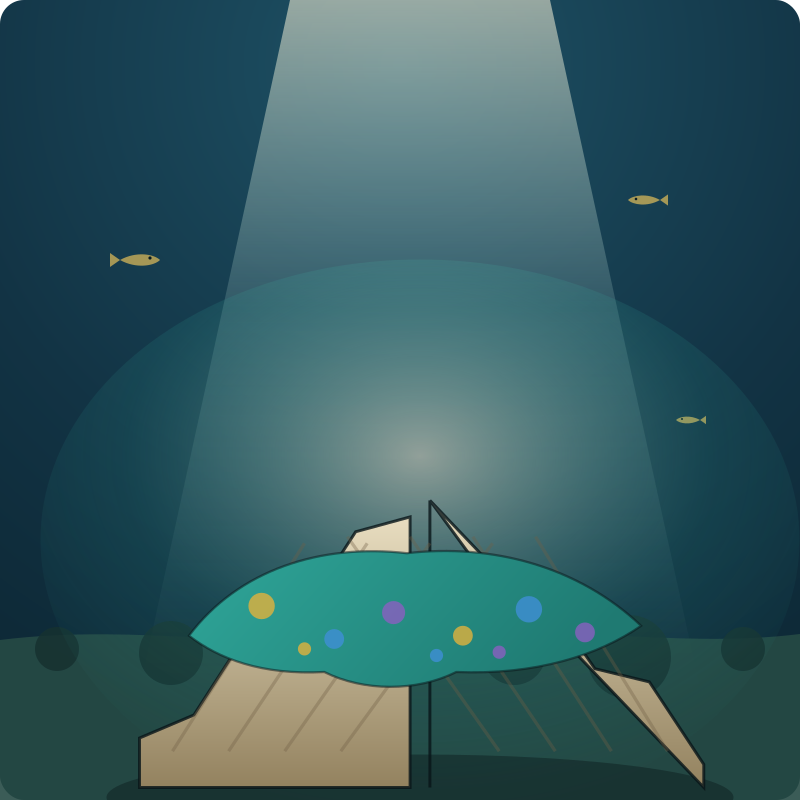
Meet the Giant Clam
A body large enough to frighten people, and far too slow and gentle to ever earn it.
The largest living bivalve on Earth, fused to one patch of Indo-Pacific reef and running almost entirely on sunlight it catches through its own flesh.
Everything this reading says about you is grounded in what the Giant Clam actually is: an animal that commits to one exact location for a lifetime that can outlast a century, farms its own food from sunlight through algae living in its mantle, and wears a reputation for danger its own body cannot support. This chapter is that foundation. The rest of the page draws its meaning from these real traits.
The size was never the danger. The story people tell about the size is.
6 traits below
01of six
The chosen ground
A Giant Clam begins life as a swimming larva and drifts for one to two weeks before it settles onto a reef, cements itself in place, and fuses to that exact spot for the rest of its life, a life that can run past a century.
You do not treat commitment as a phase you'll revisit. Once you choose your ground, you build the rest of your life around never asking the question again.
02of six
The farmed light
The clam's fleshy mantle hosts millions of single-celled algae it shelters and supplies with carbon dioxide; in return, the algae photosynthesize sugars that can provide up to 90 percent of the clam's nutrition, letting it grow to hundreds of kilograms largely on sunlight.
You have built a version of yourself that runs on very little taken from anyone else. What sustains you is mostly generated in-house, and it shows in how rarely you actually ask for something you could grow yourself.
03of six
The pattern no one else wears
Iridescent cells called iridocytes scatter light across the mantle's surface in a color pattern that is unique to each individual clam, no two alike, closer to a fingerprint than a uniform.
You are more legible than you think. The exact way you show up, the specific color of it, belongs to no one else, even on the days you'd rather assume you blend into everyone doing the same job.
04of six
The hundred small eyes
Hundreds of simple, pinhole eyes line the rim of the mantle, sensitive only to light and shadow; when something passes overhead, the clam can retract its mantle and draw its valves shut within seconds.
You notice a shift in the room before you could explain what changed. The reaction arrives as a full-body flinch, not a thought, and you have learned to trust the flinch before you trust the explanation.
05of six
The myth that outlived the evidence
Despite a 'killer clam' myth old enough to appear in a U.S. Navy dive manual, the shell's closing motion takes several full seconds of muscle contraction, far too slow to trap a limb, and no authenticated human death has ever been recorded; a fully grown clam, in fact, can no longer close its shell all the way.
The story people tell about you outpaces anything you've actually done. You get read as a threat by people who have never once been given a reason, and you rarely bother correcting them, because the myth does guard work the truth never could.
06of six
The heat it cannot swim away from
When the surrounding water grows too warm, the clam expels the very algae feeding it, the same bleaching response seen in corals, and because it has no way to relocate to cooler water, it survives on stored reserves until, and unless, the water recovers.
When circumstances turn against you, your instinct is not to leave. It is to keep functioning on less until the situation either passes or does not.