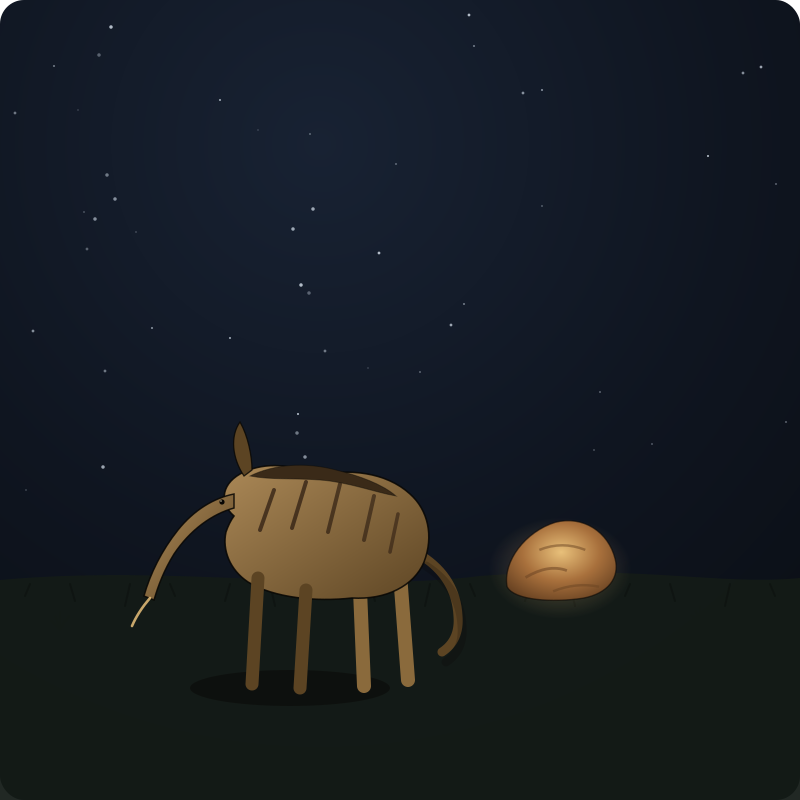
Meet the Aardwolf
A member of the hyena family that gave up the kill for the mound, and eats more than any of them.
A small, striped member of the hyena family that lives across the dry grasslands of eastern and southern Africa, built like its fiercer relatives and living nothing like them.
Everything this reading says about you is grounded in what the Aardwolf actually is: a hyaenid that abandoned the kill for the termite mound, built with a tongue for lapping and teeth too weak to properly bite, marking a shared territory with scent rather than force, and doubling back on its own tracks rather than standing to fight. This chapter is that foundation. The rest of the page draws its meaning from these real traits.
The stripes were never the threat. The gentleness underneath them was the entire point.
6 traits below
01of six
The nightly lap
An Aardwolf can lap up up to 300,000 termites in a single night using a long, flat, sticky tongue, feeding almost exclusively on harvester termites of the genus Trinervitermes, and consuming an estimated up to 105 million termites a year.
Your appetite operates at a scale most people never see, taken in thousands of small, patient passes rather than one dramatic act. You give enormously without anyone noticing you gave at all.
02of six
The teeth that stopped needing to bite
Its cheek teeth are reduced to small, blunt pegs incapable of chewing meat, and its canines, though retained, are used mainly for defense and dominance displays rather than killing prey. Aging Aardwolves often lose teeth outright with little effect on feeding, since termites require no chewing at all.
Taking in has always come more naturally to you than fighting over it. What looks like a weapon in you has mostly stopped being used for the purpose it was shaped for.
03of six
The paste-mark
Both sexes carry an anal scent gland and mark territory by pasting a black secretion onto grass stalks in short streaks, sometimes over 200 times in a single night, especially along a territory's edges.
You defend what is yours by leaving a signature behind rather than by confronting whoever crosses it. The boundary is real. It is just rarely enforced in person.
04of six
The pair that forages alone
Mated pairs share and defend a joint territory of one to four square kilometres, yet forage separately almost every night, each covering ground alone while the male spends hours guarding the den when cubs are small.
You can be fully committed to one other and still do the actual work of surviving by yourself. Partnership, for you, is a shared address, not a shared errand.
05of six
The bluff before the flight
When confronted, an Aardwolf rarely fights: it typically raises the mane along its spine to look larger than it is, doubles back on its own trail to confuse a pursuer, and, only as a last resort, releases a foul secretion from its anal glands.
Your first response to threat is theater, not violence: get big, get confusing, get gone. You would rather spend the effort looking dangerous than proving it.
06of six
The ear tuned to the dark
Large, upright ears let the Aardwolf locate termite colonies at night by the sound of soldiers drumming inside the mound and by scent, hunting almost entirely after dark and retreating underground before sunrise.
You notice what is happening below the surface of a situation before it becomes visible to anyone else. Often, you have already found the thing everyone else will hear about later.