Taurus Year of the Horse

Moose

You move through the heaviest terrain with ease, until someone asks you to hurry.

Symbolic element Earth Western Taurus Chinese Horse
Challenge a friend Test a bond

Your birth-year element is revealed only when you enter a date. The element above is the animal's symbolic element.

Why this animal

Why the Moose carries this crossing

The moose is the largest member of the deer family, unbothered in deep water and chest-high snow, solitary and unhurried, with antlers that shed and regrow annually as the largest of any living animal. It does not flee danger so much as absorb it with sheer presence, and it becomes genuinely dangerous only when cornered or surprised. That is Taurus's patient, sensory steadiness meeting the Horse's restless energetic drive: an animal built for endurance that secretly carries a current of wild momentum underneath the calm exterior.

Two zodiacs, one animal

What each half brings

Taurus brings

Taurus brings the builder's patience: sensory depth, the ability to move through difficulty without rushing, and a devotion to the space and rhythm already established. It supplies the calm that makes the moose nearly impossible to rattle and the stubbornness that keeps it on the same track season after season.

The Horse brings

The Horse brings a genuine need for open space and movement, a restless current that does not fit inside fences, and a free-spirited energy that shows up as occasional unpredictable surges. It supplies the momentum and the strong physical vitality that make the moose's calm look more like contained power than passivity.

The crossing

Where Taurus and Horse meet

Together they make a creature of enormous presence that prefers its own pace and will not be managed, who carries a wild streak so deep that most people miss it until it surfaces. You are steady until you are suddenly not, and the suddenness surprises even you. The quiet question underneath you is whether the calm is genuine ease or whether it is freedom deferred.

Nature

How this shows up in you

Your first instinct in any crowded or pressured situation is to lower your head and keep moving at your own pace, letting the noise pass around you rather than engaging it. You are built for difficult terrain, and you read that as evidence that the terrain is simply where you belong, not that anyone helped you get ready for it. You carry enormous physical and emotional endurance and a low tolerance for being redirected once your direction is set. Under pressure you tend to either absorb everything without visible reaction or erupt without warning, and the gap between those two states confuses the people who thought they knew which one was coming.

Gifts

What this animal does well

Protective instinct

What this animal guards, and how

You protect by placing yourself between the threat and the ones you care about and making your presence unmistakable, the way a moose at the edge of a clearing requires no announcement. It is not theatrical, it is simply fact.

Shadow

How it distorts under pressure

What trips it. Being pushed to move faster than your natural pace, or having your direction questioned by someone who has not earned that standing.

Your steadiness is real, and you have learned to call your resistance patience. You can hold a course so completely that the course becomes its own justification, separate from whether it is still the right one. The mechanism is this: changing direction would mean the time spent in the current direction was a kind of error, and that is a weight you are not willing to carry, so you keep going. The sharp line is this: you are not the last one still standing, you are the last one still standing in the wrong field.

What it costs. The people around you adjust to your pace and your direction and eventually stop offering alternatives, not because they agree but because they have learned the offer will not be received. You move alone through territory you could have mapped with others, and you call it independence.

Awakened form

The same strength, integrated

The awakened Moose carries the same endurance and loses the fixed direction. You move through difficult terrain with the same ease, and you let the terrain tell you something about where to go rather than confirming what you already decided. The antlers shed and regrow, and you stop calling the shedding a failure. What you built last season was the right structure for last season, and releasing it is how you get bigger.

One practice to begin

Near the new moon, identify one route you have been on so long you stopped checking whether it still goes where you intended, and walk one small step in a different direction.

The five gates

A reading in five doors

Gate of Ground

Where you stand now

You are capable and solitary in terrain most people would not enter, and you have been on this particular path longer than you have asked yourself why.

Gate of Hunger

What is asking for attention

To move freely and at full size without having to justify the pace or the direction to anyone.

Gate of Season

What to build next

This cycle, let one trusted person suggest a different route and follow it without arguing for the original, even if you are right about the original.

Gate of Shadow

What could quietly distort your path

The fixed course: the moment you recognize a redirect as a threat rather than information. Notice it, and let the terrain teach you something before you lower your head again.

Gate of Form

The person you become when integrated

The Unhurried Mover, who holds course through difficulty and sheds and regrows with each season. Near each new moon, release one direction held past its usefulness.

The Habitat

Living with your animal

An Earth nature needing Fire to keep it vital and Wood to keep it flexible. [Traditional] Earth moderates Water and is supported by Fire; without Wood to give it structure and movement, Earth stagnates. [Primal] For the Moose, use warm dark wood tones with one Fire element, a candle or lamp, and one living Wood element, a plant or branch, to keep the space alive and moving rather than a monument to what was already decided.

Sanctuary zone

A large, uncluttered room with high ceilings or the sense of them, where your size is accommodated rather than apologized for.

Materials and form

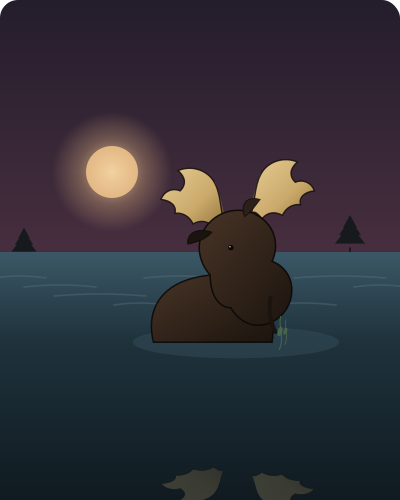
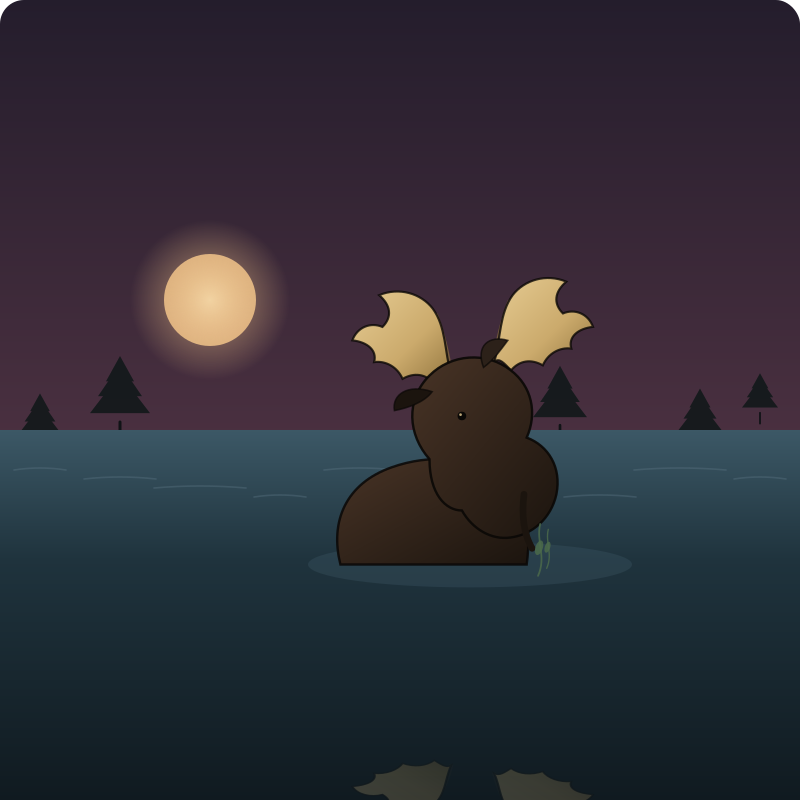
Raw wood, worn leather, dense woven wool, surfaces that age honestly and improve with use. A vast silhouette in still water, antlers wider than any frame, unhurried and complete.

Colors

  • Anchor: Boreal brown (a deep warm bark brown, #5c3d20)
  • Supporting: Antler velvet rust (a warm red-orange, #b5522b)
  • Activating: Snowfield grey-white (a cool clean off-white, #e8e4db)
  • Use sparingly: Northern spruce (a deep forest green used in small amounts, #2d4a35)

Room by room

  • Bedroom. Dark warm tones, textures of real weight, a mattress that feels like the earth, minimal surfaces so the space breathes.
  • Work area. A large, solid desk with room to spread, natural light, one living plant, nothing that signals urgency.
  • Entry. A calm, wide threshold with a place to set things down and a moment to arrive before the house makes demands.
  • Living area. Furniture built to last, warm low lighting, a clear open center of the room so movement is never blocked.
  • Reflection space. A north-facing corner with low indirect light for the new-moon practice of releasing a fixed direction.

Reduce or remove

  • Low, cramped furniture that physically compresses a nature built for open terrain and wide movement.
  • Rigid room arrangements that cannot be altered, since a creature that needs to move at its own pace needs the option to reroute even inside.
  • Clocks and time-management objects in prominent positions, since external timekeeping conflicts with the internal pace that makes you most effective.

Seven-minute reset

Go somewhere with actual physical space, outside if possible · Move slowly through it without a destination for five minutes · Stop when something catches your attention · Stay there without doing anything about it · Ask yourself what direction you have been on longest · Ask yourself when you last checked whether it still goes where you meant · Walk one step in a different direction before you go back

Feng Shui elements here are symbolic. They support intention and act as visual reminders. They are not claims that any object, color, or direction produces wealth, health, romance, or success.

Keeper Stones

Symbolic materials for this animal

Jasper AnchorJasperA grounding stone of patient endurance, for the steady pace that moves through difficulty without performing effort.Care: Safe in water briefly; keep from hard impacts.
Tiger's Eye ClarityTiger's EyeA stone for seeing the terrain honestly, for distinguishing stubborn wisdom from stubborn habit.Care: Safe in water briefly.
Carnelian CourageCarnelianA warm stone for the nerve to change direction, for shedding the route that has become its own reason.Care: Colour fades with prolonged sun.
Black Tourmaline BoundaryBlack TourmalineA grounding stone for the boundary between your pace and other people's urgency, so outside pressure does not become internal noise.Care: Rinse and dry.

Stones are cultural and symbolic tools, not medical treatment. Some are unsafe in water or fade in sunlight; a few can be brittle around children or pets. Follow the care note for each. See the stones chosen for each animal, or read where they come from in the birthstone and moonstone traditions.

Moon rhythm

Working with the phases

These phases are a practice you can keep. Charge what you carry with moonlight charging, and read the wider moon cycles behind them.

In relationship

How this animal shows up with others

As a friend

You are the friend who stays. You do not exit friendships easily, do not renegotiate terms, and show up with the same reliability across decades. People learn to trust your presence as a physical constant. The growth is letting a close friend redirect you occasionally, following their map for once rather than holding the route, so the friendship stays a conversation rather than a parallel walk.

In love

In love you are devoted, unhurried, and deeply physical, a partner who builds the relationship the way you build everything: slowly, with quality materials, intending it to last. You give your full presence once you have chosen, and you need a partner who understands that your pace is not indifference. The work is letting your partner's different pace teach you something rather than simply waiting for them to match yours.

In family

You are the weight-bearing structure of the family, the one whose constancy makes everyone else's fluctuation possible. You hold the same rituals, the same presence, the same directional gravity season after season. Let the family see you shed and regrow occasionally, so they know the constancy is alive and chosen rather than just geological.

At work and in creative partnership

You work best in roles with long time horizons and clear ownership, where depth and endurance matter more than responsiveness and speed. You build things that last and you expect credit for the building, not the announcement. You stall badly in environments that measure motion over substance or that redirect you before the work is complete.

Compatibility describes the pattern of a bond, not whether two people belong together.

Direction

Where to face

Your directions

  • Primary. Southwest
  • Supporting. Northeast
  • Recovery. West

How to use it

Southwest holds belonging and ground; Northeast holds quiet study. A fixed center in the room matters more to you than any single compass point.

A direction is a reflective cue, not a rule. Adapt it when a room cannot follow it.

Nourishment

How this animal eats well

Your guiding flavor is sweet and rooted, leaning neutral and steadying. This suits squash, whole grains, root vegetables, and honest simple plates. A gentle counterweight is constant grazing that blurs where one meal ends and the next begins.

The table ritual

A set table, one meal at a time, with the screen away. Strongest in late summer.

This is symbolic and cultural, not nutrition or medical advice. No food heals or guarantees anything, and this is never a diet.

Moon for you

The phase that serves you

You build best at the first quarter, when there is something solid to push against. At the dark of the moon, stop building and let the ground settle.

Best days

Favorable days ahead

In the Chinese tradition each day carries its own animal. Days ruled by the Horse's allies tend to favor connection and fresh starts; days ruled by its opposite ask for a little patience.

Symbolic timing for reflection, not a promise about any day. See your full calendar of best days.

Want to keep this? A free account, coming soon, saves your animal across devices and opens the deeper readings we are building.

See what members get

Bonds

Who this animal meets

Natural allies

Growth through contrast

Compatibility describes the pattern of a bond, not whether two people should stay together. Test two birthdays in the Match Oracle.

Continue your descent

Six ways onward from the Moose

Each crossing opens onto others. These are meanings to explore for reflection, not verdicts. Contrast is a mirror for self-knowledge, never a warning.

The proverb of your year

A proverb for the Year of the Horse

Where this sits

Climb back up the system

The Moose is one crossing of two zodiacs. Follow either half up to its hub, or step back to the whole set.

Return to the full Menagerie of 144 animals · What is a Primal Zodiac Animal

Common questions

Questions about the Moose

What is the Moose in the Primal Zodiac?

The Moose is the Primal Zodiac Animal of Taurus and the Year of the Horse. It is the single creature at the crossing of the Western Sun sign Taurus and the Chinese zodiac Year of the Horse, one of 144 combinations, and its reading is a lens for reflection rather than a forecast of events.

What signs make the Moose?

The Moose is made by crossing two zodiacs: the Western Sun sign Taurus and the Chinese zodiac Year of the Horse. The month and day of a birthday set the Taurus half and the year, read against the lunar calendar, sets the Horse half.

Which animals does the Moose get along with?

Its natural allies are Sable Antelope, Snow Petrel, Banded Mongoose, the crossings its instincts trust on sight. Contrast with other crossings is not a warning but a mirror for self-knowledge.

Explore

An interaction made only for the Moose

A moose standing in a still northern lake, antlers spread wider than the frame, each tine a different aspect of the nature. Six tines hang as elements: endurance, presence, wildness, fixed course, devotion, and renewal. The antlers are heavy and held without effort. Five tines are solid bone, set and certain. The sixth, renewal, bends slightly at the tip, and it is the one that catches the light. It sways only when the moose decides to move, not when the wind pushes, but when the animal itself chooses a new direction.

This experience is being built for phones. For now, here is the concept that will guide it.

Your result, in one line

I am the Moose: moving through impossible terrain at my own pace, learning to shed the route that no longer goes where I mean. Taurus steadiness with the Horse's wild current.

markers, injected before ). Edit THIS file, re-run the build, and every page updates. All links are real site paths; styled sitewide by site/css/footer.css (.v2-foot). No JavaScript. ============================================================ -->