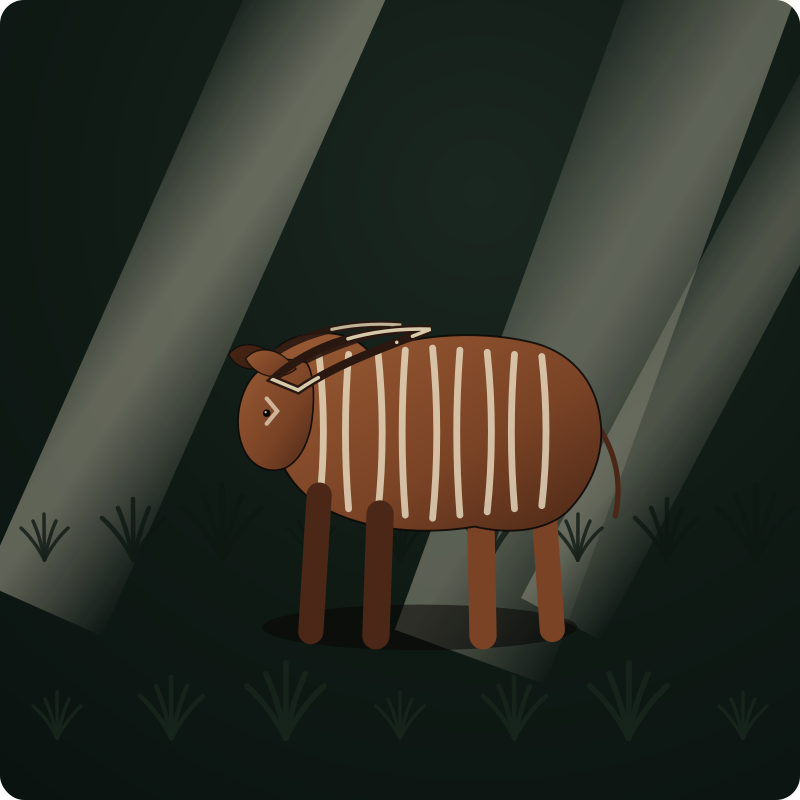
Meet the Bongo
The forest's most vivid animal, built to never be found.
The largest of Africa's forest antelope, a chestnut-and-white shape that moves through the densest lowland and montane rainforest of Central and East Africa and is rarely confirmed even by the people studying it.
Everything this reading says about you is grounded in what the Bongo actually is: an animal marked so specifically that no two coats read exactly alike, built to dissolve into broken forest light, quick to fold its own horns flat and vanish into cover at the first sign of a threat. This chapter is that foundation. The rest of the page draws its meaning from these real traits.
The color was never the risk. The forest you keep choosing over it is.
6 traits below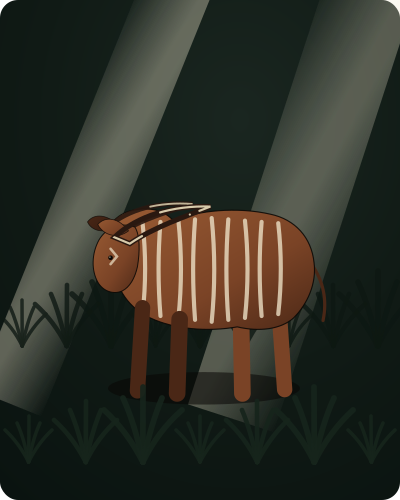
01of six
The stripe no one repeats
Between 10 and 15 vertical white stripes cross the flanks of every Bongo, and the exact count and layout rarely match from one side of an animal to the other, let alone between two individuals; researchers now use the flank pattern, alongside facial markings and horn shape, to identify single wild bongos from camera-trap photographs.
You carry a version of yourself specific enough that no one else could be mistaken for it, and you have still arranged your life so that almost no one gets close enough to actually read the pattern.
02of six
The break in the light
The Bongo's chestnut-to-mahogany coat, broken by its white stripes, functions as disruptive camouflage in the patchwork of light and shadow under a closed forest canopy, breaking up the outline of the body against the surrounding stems and hanging vines.
What looks, in the open, like the least subtle color choice available becomes, in your actual habitat, the reason no one can quite locate your edges. You are legible only in the wrong light.
03of six
The horns laid flat
Startled at full speed, the Bongo runs through the densest tangles of vines and undergrowth with its heavy, spiral horns laid back along its spine, so the brush cannot catch and slow it.
The most impressive thing about you is also the first thing you know how to fold away. When it is time to actually move, you do not lead with what people came to look at.
04of six
The pale tip
As a Bongo matures, the tips of its horns lose pigment and pale to an ivory color, a visible mark of age carried on the one part of the body that shows above the brush.
Whatever proof you have of your own history shows only at the very top, in the part of you that occasionally clears the cover. Nobody gets the whole record. They get the tip that happened to show.
05of six
The watching retreat
Bongos are considered among the most difficult African antelope to observe in the wild, even by researchers actively tracking them; once alarmed, an animal retreats into cover, angles its hindquarters toward the disturbance so it can break away instantly, and checks the source only in glances.
A threat rarely gets your face. It gets your exit, already mapped, while you glance back just enough to track it, the way a startled Bongo angles its hindquarters to the noise instead of confronting it. From the outside, that can look a great deal like composure.
06of six
The scattered last few
The eastern, mountain Bongo subspecies is Critically Endangered, with an estimated 100 to under 150 animals remaining across a handful of fragmented Kenyan forests, isolated from one another by logging and decades of hunting; more of the subspecies now live in captivity than in the wild.
The version of you people keep, display, and can reliably find is not the same as the one still out there, uncontained, thinned by every year it has had to go unnoticed.