Meet the Fossa
A body built to rule a whole forest alone, that opens completely only once, and only by its own choosing
Madagascar's largest native carnivore, a slender, cat-faced climber that hunts lemurs through the canopy from dusk into the dark, though it is closer kin to a mongoose than to any cat.
Everything this reading says about you is grounded in what the Fossa actually is: a solitary hunter that marks a whole forest as its own, descends a tree trunk facing straight down instead of backing away from the drop, and breaks its own solitude exactly once a year, at one tree, for as long as it takes to choose. This chapter is that foundation. The rest of the page draws its meaning from these real traits.
The range was never the loneliest part. The one tree is where it actually gets tested.
6 traits below
01of six
The head-first descent
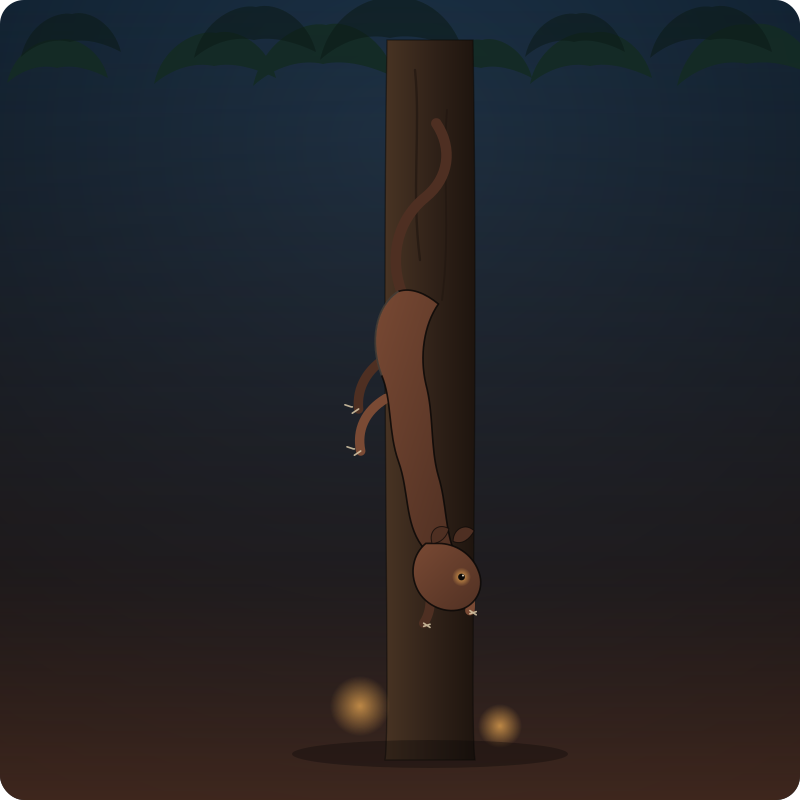
Semi-retractable claws and unusually flexible ankle joints that rotate to grip a trunk from any angle let the Fossa climb down a tree facing straight downward, head first, rather than backing down tail-first the way most climbers do; the same joints let it leap between trees.
The way down rarely gets turned into a retreat: once you have committed to a height, you go the whole way facing it, and you have never found backing away easier than descending.
02of six
The mismatched name
Despite a compact, cat-like face and a body long compared to a small cougar, genetic studies place the Fossa in Eupleridae, the family most closely related to Madagascar's mongooses, not to true cats at all; the resemblance is convergent evolution, not ancestry.
People decide what you are from across the room, and they are usually wrong about the family you actually belong to. You have stopped correcting most of them.
03of six
The marked range
Male Fossas hold territories of up to 26 square kilometres, over twice the size a female defends, and scent-mark rocks, trunks, and open ground year-round from glands near the tail and chest so the border can be read without a confrontation.
A boundary understood at a distance beats one enforced up close, over and over, and you would rather mark it once and expect it to hold.
04of six
The one tree
Mating concentrates at a small number of traditional trees reused year after year, on almost the same date each season, on a horizontal limb some twenty metres up; as many as eight males gather near a single female, who chooses, and often changes, her partner over several consecutive days.
The one door you open, you open on your own calendar, to a crowd you allow, and you are the one doing the choosing, not the one being chosen at random.
05of six
The prey twice its size
The Fossa is the only predator able to take an adult of every lemur species on the island, some weighing close to 90 percent of its own body mass, and during the breeding season it has been seen hunting in loose pairs, driving prey out of the canopy toward a partner waiting on the ground.
Things that outweigh you rarely wait for backup to be worth going after, and on the rare nights you do ask for help, it is because the target genuinely calls for two.
06of six
The bed that doesn't repeat
Outside of raising young, a Fossa rarely sleeps in the same spot two nights running; only a mother denning with cubs returns reliably to one place.
Almost nowhere gets to expect you twice. What does is the part of your life you are actually raising something in.