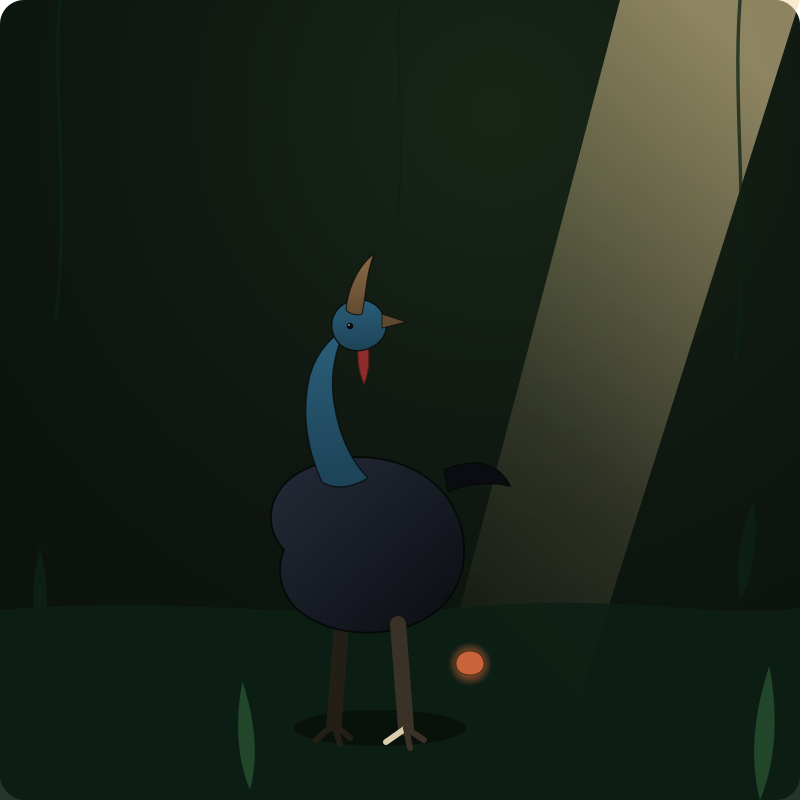
Meet the Cassowary
One of the most feared claws alive, spent almost entirely on quietly feeding a forest that needs it to keep growing.
A flightless giant of New Guinea and northeastern Australia's rainforest, dagger-clawed and quiet, moving alone through undergrowth few other animals can cross.
Everything this reading says about you is grounded in what the Cassowary actually is: a bird carrying one of the most feared claws in the animal kingdom that it almost never uses, a solitary forager whose call drops below what most ears can register, and one of the only animals alive that can swallow a rainforest's largest fruit whole and carry the seed somewhere it can actually grow. This chapter is that foundation. The rest of the page draws its meaning from these real traits.
The claw was never the whole story. What quietly keeps growing back around you is.
6 traits below
01of six
The claw
The innermost toe carries a straight, dagger-like claw that can grow to roughly 12 centimetres, capable of a forward kick strong enough to cause severe injury; it is used almost exclusively in defense, and documented attacks are overwhelmingly provoked, most often tied to a bird associating a person with food.
You carry something sharp enough to end an argument and reach for it only when you are actually cornered. People clock the weapon long before they clock how rarely it comes out.
02of six
The casque
A tall, hollow structure of keratin sits atop the head, and its exact purpose is still debated: researchers have proposed it as a signal of age or dominance, a helmet for pushing through dense growth, a receiver for low-frequency sound, and, per a 2019 thermal-imaging study, a vent for shedding heat.
The most visible thing about you does more than one job at once, and most of it is never explained. People are left guessing at the crown, while it quietly does several kinds of work no one asked about.
03of six
The boom
The Cassowary's call can drop to roughly 32 hertz, near the bottom edge of human hearing and among the lowest-frequency vocalizations recorded in any bird, likely suited to carrying between solitary individuals spread through dense rainforest that cannot see one another.
You reach people you cannot see and have not spoken to directly, and you do it with almost nothing anyone would call loud. What travels from you is felt in the chest before it is understood as a message.
04of six
The solitary claim
Outside of breeding, Cassowaries are largely solitary and defend an individual home range; males alone build the nest, incubate the clutch for roughly fifty days, and raise the chicks with no help from the female.
Alone is how you hold your ground, and alone is how you finish what you start, including the parts everyone assumes get shared. The territory and the labor both stay entirely yours until you decide otherwise.
05of six
The forty-mile run
Despite its size and flightless body, the Cassowary can run up to roughly 50 kilometres an hour through dense undergrowth and clear obstacles with a near-vertical jump, built for fast, unpredictable movement through terrain that stops almost everything else.
Your stillness is not slowness. When the ground actually calls for it, you move through the same tangle that stops everyone else, and you do it at a speed nobody priced in.
06of six
The seed no one else can carry
The Cassowary swallows large rainforest fruits whole and passes the seeds intact in its droppings, sometimes kilometres from the parent tree; it is considered a keystone species because it is the only long-distance disperser for a number of large-seeded rainforest plants, some of which depend on passing through a cassowary to germinate at all.
Something in your orbit needs you specifically, not just anyone your size, to move forward at all. You do the carrying so quietly that most of the forest never finds out who planted it.