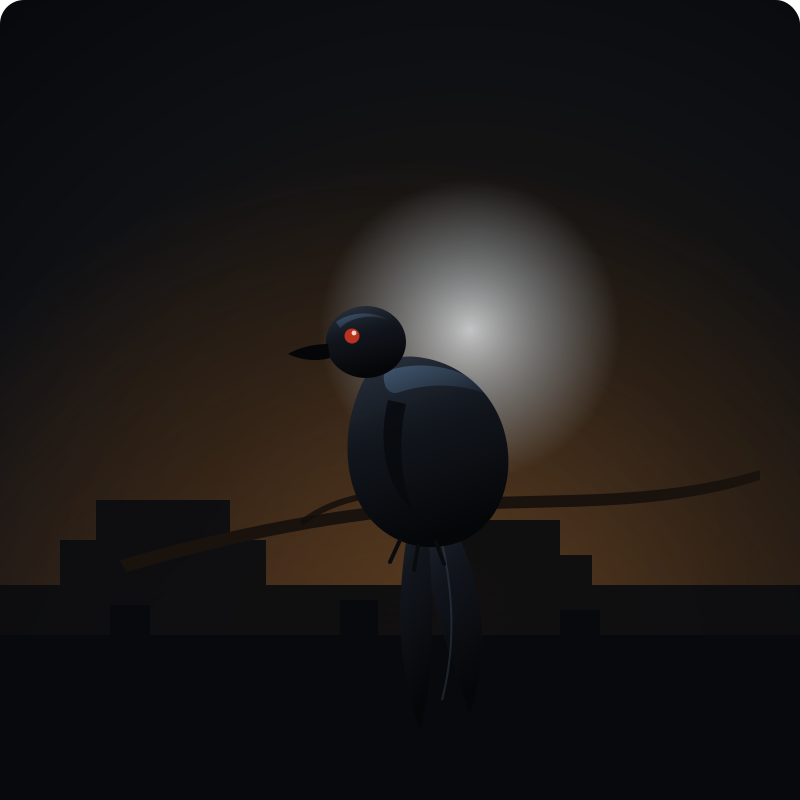
Meet the Fork-tailed Drongo
A voice you can't always trust, on a body that fears nothing above it.
A glossy black, red-eyed songbird of Africa's savannas and open woodland, small enough to perch on a warthog's back and bold enough to dive at a hawk twice its size.
Everything this reading says about you is grounded in what the Fork-tailed Drongo actually does: it steals food by making other animals believe a threat is coming, and it changes that lie the moment the old one stops working. It also, unrelated to any theft, defends its nest against animals it has no real chance of beating in a straight fight. This chapter is that foundation. The rest of the page draws its meaning from these real traits.
The call was never the whole trick. Knowing when to change it was.
6 traits below
01of six
The false alarm
In field studies, fork-tailed drongos stole food from other species, including meerkats and pied babblers, in roughly half of their kleptoparasitic attempts by giving a false alarm call from a perch while the target handled food, causing it to flee to cover and abandon the meal, which the drongo then took.
You have a way of changing the temperature of a room with a few words, and you have used it to get something you wanted. It is rarely cruelty. It is closer to knowing exactly which sentence moves a person faster than the truth would have.
02of six
The borrowed voice
These false alarms are not always the drongo's own sound. Drongos frequently mimic the specific alarm calls of the very species they are targeting, calls that studies found structurally indistinguishable from the real thing, and able to deceive both meerkats and pied babblers in playback experiments.
You can speak in someone else's language when it gets you further than your own, matching a concern a person already carries instead of inventing a new one. It works because you are rarely lying about what they should be alert to, only about whether it is happening right now.
03of six
The switch
Target species habituate to a repeated false alarm and stop abandoning food in response to it. Researchers have documented drongos changing which call they use against a habituated target, deploying a different or rarer mimicked alarm to restore the deception's effect.
You notice, faster than most people notice being noticed, the exact moment an approach has gone stale on someone. Your instinct is not to push the same line harder. It is to reach for a different one before the old one costs you anything.
04of six
The mob
Fork-tailed drongos, weighing around fifty grams, are documented attacking and mobbing far larger predators, including hawks, especially near the nest, diving at birds many times their own size.
The same bird that talks its way around a fight will not avoid a real one. When something threatens what is actually yours, the calculation disappears and you go in anyway, size be damned.
05of six
The forked tail
The Fork-tailed Drongo is described as a red-eyed, all-black bird with a narrow tail that splays into a deep fork, an unmistakable silhouette on an open perch.
You are easy to spot and hard to read. People notice you immediately and still leave a conversation unsure of what you were actually watching the whole time.
06of six
The flush
Fork-tailed Drongos are often found near wild and domestic mammals and other foraging species, hawking the insects that movement flushes into the open, a legitimate, non-deceptive way of finding food alongside their thefts.
Not everything you take is taken by trick. You are just as often positioned, quietly benefiting from someone else's motion without costing them anything at all.