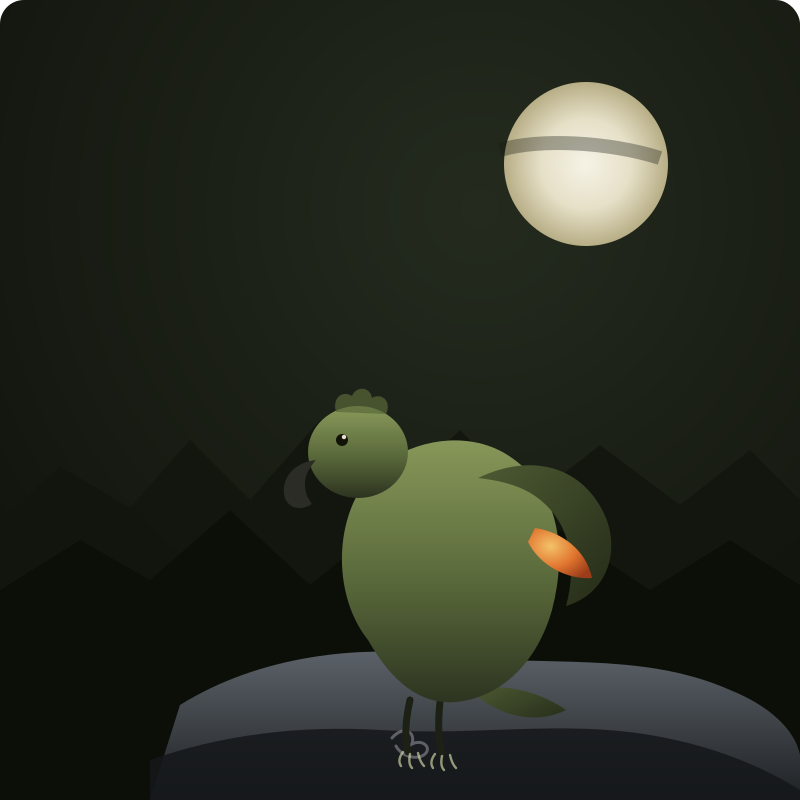
Meet the Kea
A beak built for cold stone, and a laugh no one nearby can resist.
A crow-sized, olive-green parrot of New Zealand's Southern Alps, the only parrot in the world built for true alpine altitude, marked by a flash of orange-red under each wing that shows only when it flies.
Everything this reading says about you is grounded in what the Kea actually is: one of the most cognitively sophisticated birds studied in captivity, an opportunist that investigates and dismantles the unfamiliar out of curiosity rather than hunger, and the owner of a play call documented to spread playfulness through a flock the way laughter spreads through a room. This chapter is that foundation. The rest of the page draws its meaning from these real traits.
The world was never really at risk from you. It just rarely stays exactly as you found it.
6 traits below
01of six
The only alpine parrot
Kea live only in the mountains of New Zealand's South Island, ranging through beech forest and sub-alpine scrub between roughly 600 and 2,000 metres — the only parrot species in the world adapted to true alpine conditions.
You were built for terrain that thins most people out before they reach you. What looks like distance is often just altitude doing its job.
02of six
The hooked bill
The kea's long, strongly decurved upper bill is used to dig for roots and grubs, strip bark, and pry into whatever it is investigating, a tool built for opening things more than for defending itself.
Your sharpest feature was never meant as a weapon. It is built for getting underneath, and it goes to work on a locked question exactly the way it goes to work on a locked latch.
03of six
The unlatched world
Kea are well documented investigating and dismantling human belongings on sight, prying at windshield wipers, rubber seals, and ski equipment; researchers studying the species have framed this behaviour as opportunistic, curiosity-driven exploration rather than food-motivated foraging.
You take things apart to understand them, not to ruin them, though the difference is not always visible from where the other person is standing, watching something they liked come undone in your hands.
04of six
The play call
Kea have a distinct vocalization produced during play; when researchers broadcast recordings of it to wild birds, nearby kea played more, whether or not they had been playing already, evidence that the call itself functions as a form of positive emotional contagion.
Something in your voice does the deciding before the room has caught up to it. People are already loosening before they'd admit to agreeing to.
05of six
The unranked flock
Kea live in family groups and gather in aggregations of thirty to forty birds at rich feeding sites; their dominance hierarchies are not strictly linear, so an adult can outrank a younger bird who outranks a juvenile who, in turn, outranks that same adult.
Your sense of who's actually in charge rewrites itself by the hour and by the room, and unlike most people, you are genuinely comfortable there.
06of six
The wandering years
After fledging, young kea disperse from their parents and travel together in loose flocks for two to three years before settling into an adult range.
You left home with people your own age instead of alone, and some part of you still measures a place by who else showed up, not by the address.