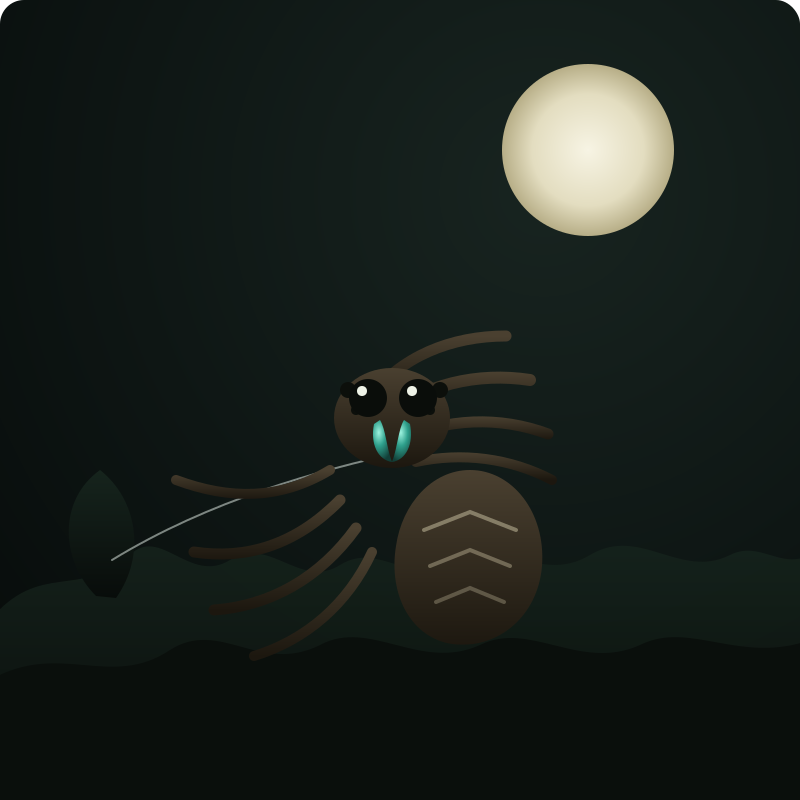
Meet the Regal Jumping Spider
The boldest jump in the yard, and the only one with a line home.
One of the largest jumping spiders in North America, native to the southeastern United States and the Caribbean, favoring palmetto scrub and open woodland, hunting by sight instead of a web.
Everything this reading says about you is grounded in what the Regal Jumping Spider actually is: an animal with some of the sharpest eyesight of any invertebrate, a hunter that stalks instead of trapping, and a jumper that never leaps without first paying out a line behind it. This chapter is that foundation. The rest of the page draws its meaning from these real traits.
The leap was never the risk. The measuring is where the actual animal lives.
6 traits below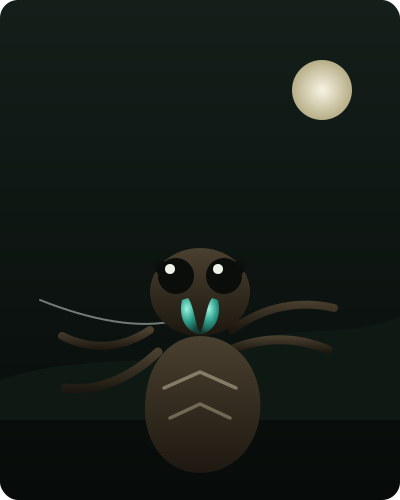
01of six
The dragline
Before every leap, the spider anchors a strand of silk to the surface behind it and jumps trailing the line. The rear legs carry serrated claws built to grip that silk safety line in mid-air, so a misjudged jump becomes a swing rather than a fall.
Your boldest moves are rarely as unsecured as they look. You commit to the leap because you already fastened the line before anyone was watching.
02of six
The measured leap
High-speed filming of a regal jumping spider across fifteen jump distances found it adjusts its take-off angle to the size of the gap: a low, fast trajectory for short jumps, a steeper, more efficient arc for long ones.
You do not have one style of commitment. You have a formula, and you run it fresh every time the distance changes.
03of six
The eye that reads blur
The spider's principal eyes hold a four-layered retina; two layers receive the same green light with different amounts of blur, and the animal uses that mismatch, not stereo vision, to judge how far away something actually is.
What looks like plain seeing, in you, is a second calculation running underneath the first. You know how far something is partly by how unclear it still looks.
04of six
The detour
These spiders have been observed taking indirect routes toward prey that has gone out of sight, pausing along the way to reorient toward its last known position, evidence of route planning rather than pure reflex.
You can hold a target in mind after it disappears and still find your way back to it. The straight line was never actually the fastest way to reach something.
05of six
The verdict
A courting male raises his legs, flashes color, and approaches in a deliberate zig-zag; the female stays still and lets him close the distance, or attacks him, and the outcome turns entirely on her read of him at close range.
Somebody else's display does not move you. Their willingness to close the actual distance and be looked at up close does. You decide at a range you have already checked.
06of six
The chelicerae
Adult females can reach roughly 22 millimetres, among the largest jumping spiders on the continent, and the front fangs, the chelicerae, carry an iridescent blue-green sheen found across most of the genus.
The part of you built for closing, for finishing the thing, is the part that actually catches the light. You were never trying to be quiet about all of it.