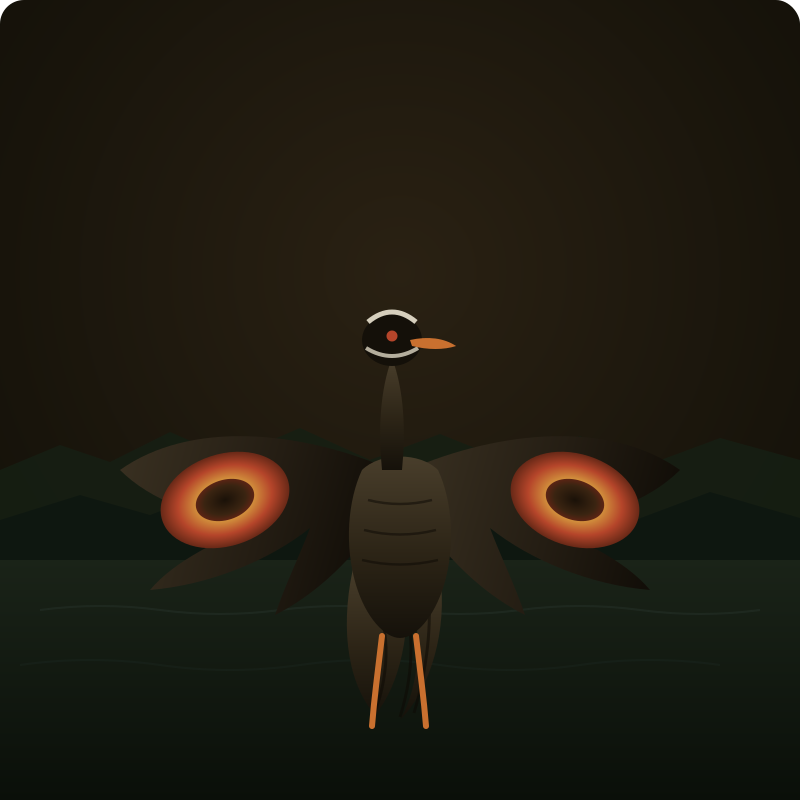
Meet the Sunbittern
A plain brown wader on a plain brown bank, until the wings open and two eyes stare back.
A solitary wader of Central and South America's forest streams, barred in brown and grey until the instant it is not.
Everything this reading says about you is grounded in what the Sunbittern actually is: a bird built to be missed at a glance, a threat display that turns its whole body into a pair of enormous staring eyes, and a lineage so old its only living relative stands on the other side of the planet. This chapter is that foundation. The rest of the page draws its meaning from these real traits.
The eyes were never the problem. Knowing when to open them was.
6 traits below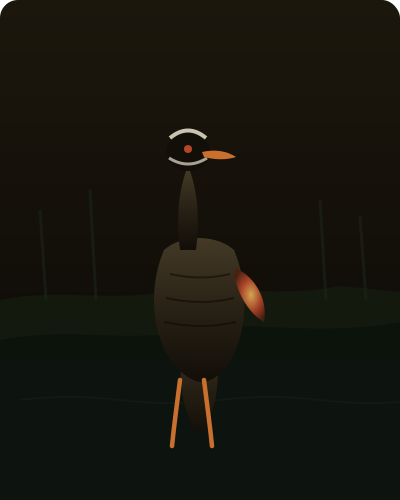
01of six
The plain approach
At rest the Sunbittern is a close, fine barring of black, brown, and grey, and the bird is often overlooked even where it is common, standing quietly along a stream or swamp edge.
You are built to read as ordinary at a glance, and most rooms take you at that valuation. It costs you nothing, until the room never learns there was anything else to see.
02of six
The sunburst
When alarmed, the Sunbittern spreads both wings and its tail into a wide, flat display of chestnut and gold false eyespots, a pattern invisible when the bird is folded and impossible to miss when it is not.
What you are holding does not grow slowly into view. It arrives at full size, all at once, and the people who only knew the folded version are rarely prepared for the rest of you.
03of six
The strike
The Sunbittern hunts by walking a stream edge in slow, deliberate steps and striking suddenly with its long neck and spear-shaped bill to take fish, amphibians, crustaceans, and insects.
Your patience is not the opposite of your speed. It is the thing that makes the speed exact. You watch a long time so that when you finally move, you only have to move once.
04of six
One bird, one bank
Sunbitterns are typically found singly or in pairs, holding a stretch of stream or forest water rather than gathering in flocks.
You do not need a crowd to feel accompanied. One stretch of ground and, sometimes, one other creature on it is the whole of what you require.
05of six
The false injury
If a nest is approached, a parent Sunbittern will often perform a broken-wing display, feigning injury to draw a predator away from the chicks before flying off unharmed.
You will make yourself the visible, vulnerable thing on purpose, if it moves the danger away from whoever is behind you. The performance is a choice, not a failure of nerve.
06of six
The lone lineage
The Sunbittern is the sole member of its family, Eurypygidae, and genetic study places its nearest living relative as the kagu, a flightless bird found only in New Caledonia, on the far side of the Pacific.
You do not come from a crowd of similar animals. Whatever you actually are, you have mostly been working it out alone.