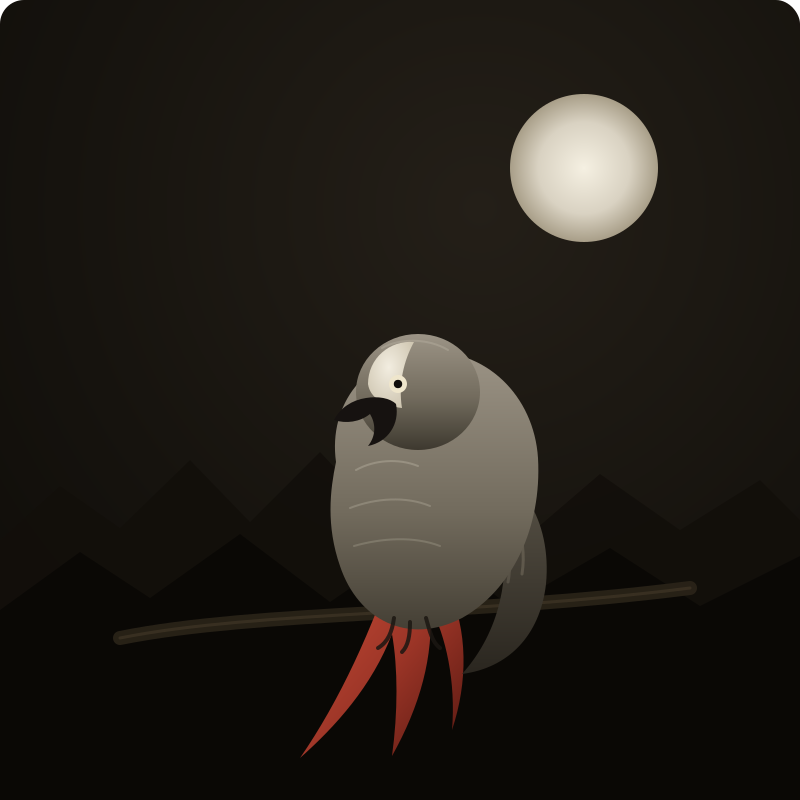
Meet the African Grey Parrot
A voice built to fill a forest, kept nearly silent until it decides the room is safe.
A grey, scarlet-tailed parrot of the lowland rainforests of West and Central Africa, one of the most closely studied minds in the animal kingdom and one of the hardest wild birds to actually get near.
Everything this reading says about you is grounded in what the African Grey Parrot actually is: a bird capable of using learned words with functional understanding under research conditions, a flock animal that roosts by the hundreds and forages in small, shifting groups by day, a mate chosen once and kept for life, and a species so wary of people in the wild that field researchers rarely get close. This chapter is that foundation. The rest of the page draws its meaning from these real traits.
The voice was never the problem. Deciding who gets to hear it is.
6 traits below
01of six
The labeled world
One African grey parrot named Alex, studied for more than two decades, learned to use English words functionally, labeling 50 objects, 7 colors, and 5 shapes, and combining those labels to identify, request, refuse, and quantify roughly 100 different items.
You rarely just repeat what was said to you. Once a word is actually yours, you use it as a tool, to name a thing correctly, to ask for what you want, or to turn something down without raising your voice.
02of six
The wary wild self
In the wild, African grey parrots are notably shy and rarely allow humans to approach them, a sharp contrast to their reputation in captivity as some of the most vocal and expressive parrots kept as companions.
The self that performs freely for a familiar room is not a costume. It is simply not the self you bring anywhere else. Almost no one ever gets to meet both of you.
03of six
The roost at dusk
Grey parrots roost communally in large, vocal flocks, often preferring islands in rivers, breaking into smaller groups by day to forage across long distances before returning to the same roosting site at dusk, with the flock falling silent from sunset until the next dawn chorus.
You can spend a whole day scattered, working a dozen separate threads of your own, and still come back to the exact same place every single night. Distance was never the same thing as leaving.
04of six
The chosen mate
Individuals select mates carefully and form a lifelong monogamous bond beginning at three to five years old, with courtship that includes mutual feeding and soft duetted calls before the pair commits to raising young together.
You do not bond quickly, and the second bond does not come easier than the first one did. Once the choice is actually made, though, it tends to outlast almost everything else about you.
05of six
The one bright feather
Grey parrot plumage runs in muted shades of ash and slate, broken by a single field of saturated color: a scarlet-red tail, the only part of the bird that is not some shade of grey.
Most of you reads as neutral on purpose. The one part you cannot dull down is usually the part that gives you away in a single glance.
06of six
The vigilant descent
Because grey parrots feed partly on the ground, foraging groups gather in a tree until it is packed with hundreds of birds, then descend to feed in waves, with the whole flock never on the ground at once, and every bird reacting instantly to the smallest movement or sound.
You rarely let a group be exposed all at once, and you rarely relax entirely even inside a crowd you trust. Someone is always still watching the tree line.