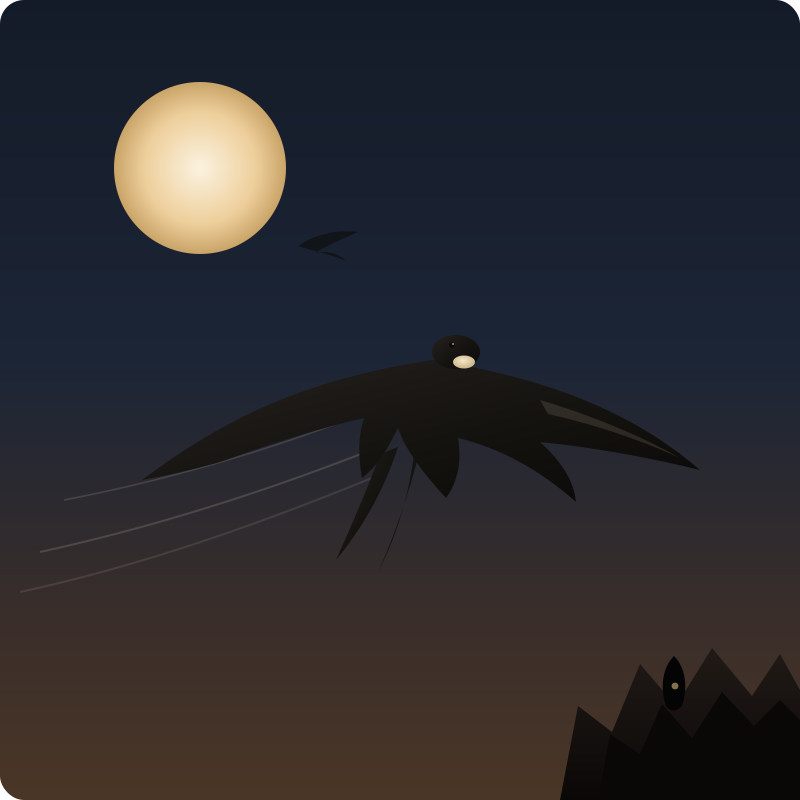
Meet the Swift
Faithful to one ledge, and gone from it for most of the year
A small, dark-winged bird of the summer sky above Europe, Asia, and Africa, built almost entirely for flight and almost not at all for the ground.
Everything this reading says about you is grounded in what the Swift actually is: a bird with feet too small to perch, that spends the greater part of its life airborne, that mates and drinks without ever fully touching down, and that returns, without fail, to one crevice and often one partner it chose years before. This chapter is that foundation. The rest of the page draws its meaning from these real traits.
The distance was never the problem. It is only a problem for whoever is waiting to be told exactly when you are coming back.
6 traits below
01of six
The foot that cannot perch
Named from the Greek for "without feet," swifts have tiny feet with sharp, curved claws built to cling to vertical surfaces, cliff faces, cave walls, building ledges, rather than to grip a branch. They cannot perch the way most birds do.
The moment you are asked to just stand still on ordinary ground, the way everyone else seems to manage easily, is the one moment your whole design works against you. You were built for the cling and the climb, not the stand.
02of six
The unlanded season
Common Swifts are unique among most birds in their ability to stay aloft for extended periods; it is not uncommon for an individual to spend an entire day on the wing, touching down only to feed young or to roost at night.
There is a version of you that exists almost entirely out of view, doing something enormous that no one on the ground is positioned to witness. You do not perform the effort. You are simply somewhere higher, still moving.
03of six
Weather read from the wingtip
Swifts fly low in cold, wet, or windy conditions and climb to higher airspace once the weather turns favorable for extended flight, adjusting altitude to conditions almost continuously.
You are recalibrating before anyone has said a word. A change in temperature, in someone's tone, in what a room is actually asking of you, and you have already adjusted your altitude to meet it.
04of six
Love conducted in the air
Common Swifts are documented mating in flight, one of the more unusual traits of the species, alongside mating on the nest itself.
Closeness does not require you to stop moving. Some of your most real connection happens exactly mid-motion, while you are still going somewhere, which is not the same thing as being unavailable.
05of six
The nest built from what passed by
Using saliva from enlarged breeding-season salivary glands as glue, Swifts cement feathers and plant material, much of it gathered on the wing, into a compact nest fixed to a single vertical crevice.
What you call home was assembled fast, out of whatever was already moving past you, and then made permanent with something entirely your own. It was never going to be built the slow way.
06of six
The same crevice, the same mate
Common Swifts are monogamous and faithful to the same nesting site, typically returning to the same crevice and partner year after year; one banded individual was recaptured at 17 years old, with a wild lifespan recorded up to 21 years.
You can disappear for most of a year and still be the most reliable thing in someone's calendar. The absence does not undo the promise. In your case, it is practically the shape of it.