
Meet the Fennec Fox
The smallest fox alive, and the only part of it built oversized is the part that never gets to rest.
The smallest fox in the world, a pale, saucer-eared hunter of the Sahara and Arabia's driest sand seas, asleep by day and awake for nearly all of the night.
Everything this reading says about you is grounded in what the Fennec Fox actually is: the smallest member of the dog family, built almost entirely around a pair of ears running two jobs at once, a burrower that never needs to drink, and a mate that keeps one partner for life. This chapter is that foundation. The rest of the page draws its meaning from these real traits.
The listening was never the problem. Knowing when it is allowed to stop is.
6 traits below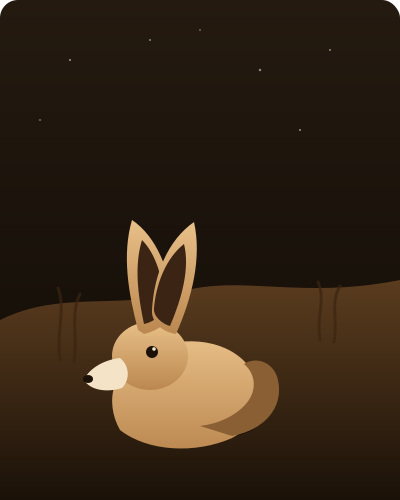
01of six
The double-duty ear
At up to 15 centimetres long, the fennec fox's ears are the largest of any canid relative to body size; their dense network of blood vessels sheds excess body heat, while the same ears and their enlarged inner-ear chambers let the fox locate prey moving under the sand.
One visible feature is doing two different jobs for you at once, cooling you down and keeping you alert, in a place that would overwhelm a creature built for only one. You rarely get to choose which job is running. Both are always on.
02of six
The furred sole
The fennec fox's feet are heavily furred, including the pads, an adaptation that insulates against sand hot enough by day to injure bare skin and cold enough at night to chill it.
You are built to cross ground that punishes anyone without your particular padding, in either direction, heat or cold, without slowing down to notice which one it is today. The insulation is the whole reason you can move at all.
03of six
The waterless body
Fennec foxes can go without drinking free water indefinitely; leaves, roots, and fruit supply nearly all the moisture they need, and their kidneys are adapted to conserve what little water they take in.
You run for long stretches on whatever moisture you can pull out of the day itself, not on anything poured for you directly. It looks like independence from the outside. It is closer to a body that has learned not to expect to be given anything.
04of six
The second door
Fennec foxes dig extensive, multi-chambered burrow systems with several entrances, often beneath the roots of desert shrubs for structural support, and neighboring family groups may share or connect their burrow networks.
You do not build a home with one way in and one way out. You build a home you can leave from any direction, and you are happiest when the people closest to you can reach your den from theirs. Safety, for you, is always plural.
05of six
The nightly clan
Fennec foxes are highly vocal for a canid, using a wide range of calls, including chattering, whimpering, wailing, growling, and short, repeated howls, to communicate within family groups of up to ten related individuals.
You are far louder than your size suggests, but almost entirely among your own. The volume is not for strangers. It is how your particular family stays in the same dark room together.
06of six
The kept mate
Fennec foxes are monogamous and pair for life; both parents provision and guard the pups for months, and older siblings frequently help rear the next litter.
Underneath the constant scanning and the constant noise is one long, quiet loyalty: a single mate, kept, while everything else about your world adapts and reshuffles around that one fixed point. The rest of you moves. That does not.