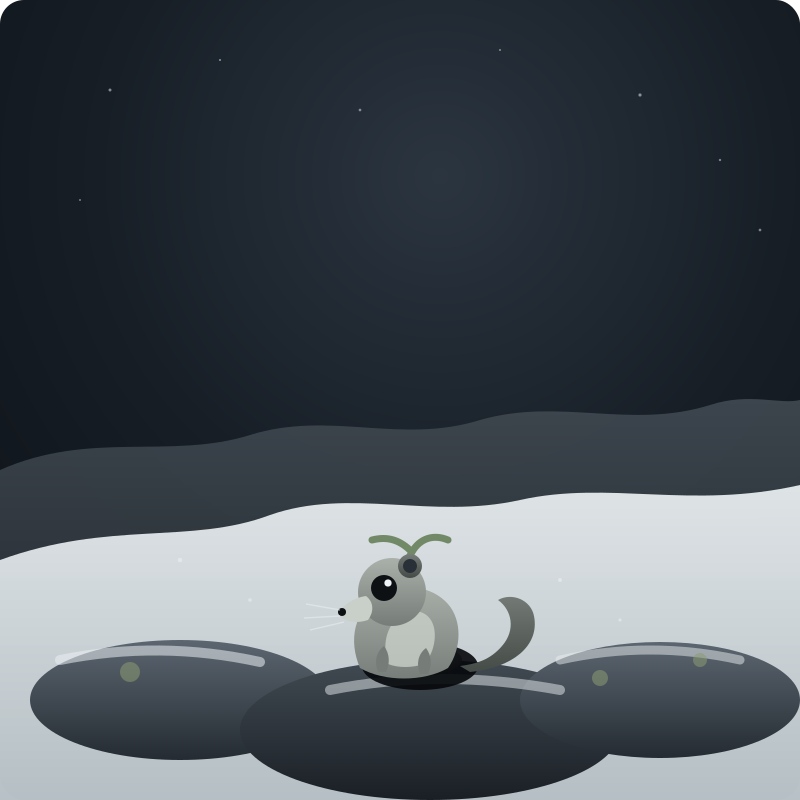
Meet the Mountain Pygmy Possum
A possum that weighs about 45 grams sleeps up to seven months under the snow, and wakes only when the snow says so.
A possum the size of a mouse, found nowhere on earth except a scatter of boulder fields above the snowline in the Australian Alps, and one of the few marsupials known to hibernate.
Everything this reading says about you is grounded in what the Mountain Pygmy Possum actually is: the only Australian mammal restricted to alpine and subalpine habitat, a hibernator that sleeps roughly half the year under snow, a hoarder of seeds against a season it cannot watch arrive, and an animal whose entire world population fits inside a patch of mountain smaller than most towns. This chapter is that foundation. The rest of the page draws its meaning from these real traits.
The measuring was never the anxious part. It is the only reason there is a mountain left to wake up on.
6 traits below
01of six
The counted gap
Mountain pygmy possums live mainly in boulderfield habitat formed by repeated freeze-thaw fracturing of alpine rock, nesting in the resulting crevices between fragmented boulders rather than digging their own burrows.
You do not build your own shelter from nothing. You find the gap that already exists, the one the right conditions already carved, and you trust it exactly as far as you have checked it and no further. The wrong gap does not get a second chance to prove itself.
02of six
The six-month sleep
Mountain pygmy possums hibernate for five to seven months, from about April until the snow melts; during torpor their body temperature drops to near 2°C, and in midwinter the den itself usually sits at about 1.5 to 2.5°C.
You go dormant for longer than the people around you can quite believe, spending down a reserve you built while everyone else assumed you were simply resting. Half a year, and none of it visible from outside.
03of six
The re-measured den
Between bouts of torpor, possums rouse and leave their dens for up to five days at a stretch, often relocating to a different hibernation site, most of all early in the season.
You do not simply endure a bad fit. You get up, in the middle of the hardest season, and move, because a den that is nearly right is not the same as a den that is right. Nearly correct still fails you.
04of six
The provisioned dark
According to Menkhorst (1995), it is the only marsupial known to cache non-perishable food, storing seeds and berries that make up more than three-quarters of its diet during the hibernation season.
You provision for a version of the future you will not be conscious enough to check on while it happens. The work has to be finished before the dark starts, because there is no revising it once you are under. You do not get to be there when it is tested.
05of six
The one migrating meal
During its spring breeding season, the possum's diet may consist almost entirely of Bogong moths, an insect that migrates into the alps from hundreds of kilometres away on a schedule the possum has no part in setting.
The one season that determines whether the next generation happens at all runs on an arrival you do not control and cannot move up. You do the parts you can measure. The rest, you simply have to be ready for.
06of six
The ten-kilometre world
The species is listed Critically Endangered by the IUCN, with its entire global population confined to less than 10 square kilometres of habitat split across three isolated alpine populations.
Almost everything you are could be contained in a space most people would call small for one life, let alone a whole kind. You have never mistaken that for a limitation. It is simply the only ground that has ever been exact enough.