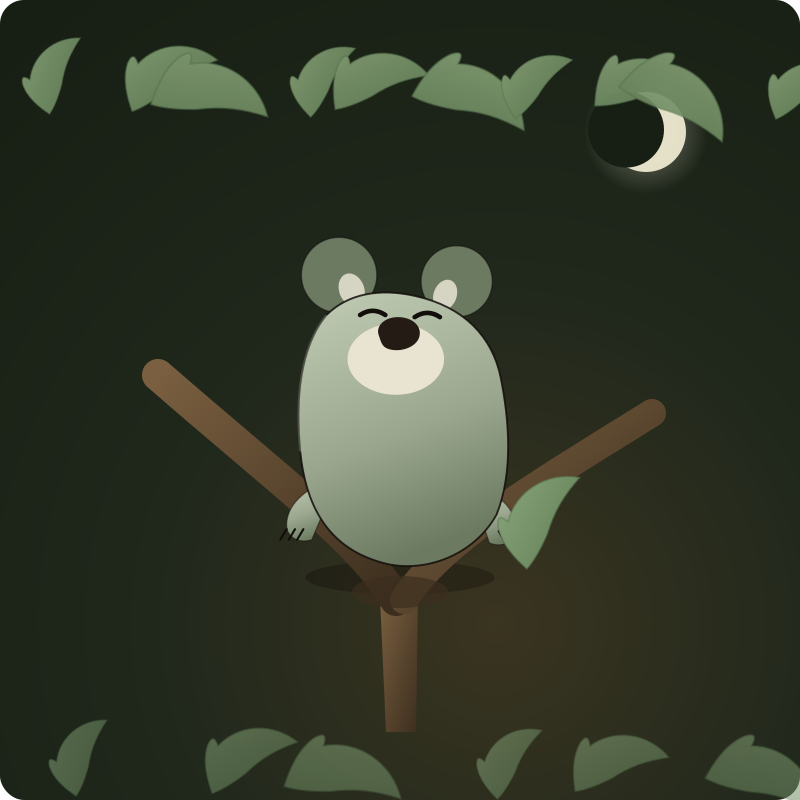
Meet the Koala
A body that spends almost nothing, so it can afford the one call that matters.
A tree-dwelling marsupial of eastern Australia, built almost entirely around a single, difficult food, and a body that has learned to spend as little as possible in order to afford it.
Everything this reading says about you is grounded in what the Koala actually is: an animal that eats a food nearly nothing else can process, sleeps away most of the day to survive doing so, and produces, from that same small quiet body, one of the most disproportionate sounds in the animal kingdom the moment it decides something is worth it. This chapter is that foundation. The rest of the page draws its meaning from these real traits.
The stillness was never the waste. It was the price of affording the one loud thing.
6 traits below
01of six
The tested tree
Even among eucalyptus trees of the identical species standing side by side, koalas have been shown to selectively visit trees with higher available nitrogen and lower concentrations of a toxic compound called sideroxylonal, a difference invisible to the eye and detectable only by taste and smell.
You register a difference in quality that other people walk straight past. That preference rarely explains itself, so you have learned to trust it anyway, because it has been right about the tree before you had the words for why.
02of six
The long gut
The koala's cecum, a fermentation chamber branching off the large intestine, reaches roughly two metres long, about four to five times its own body length, proportionally the largest cecum of any mammal, and food can take up to 100 hours to pass through the full digestive system.
You extract more from less than most people manage, but it takes time, and you cannot be rushed through the process without losing what you were trying to get out of it. Slowness is not the flaw here. It is the design: a thorough kind of extraction, never a quick one.
03of six
The long sleep
Wild koalas rest or sleep for roughly eighteen to twenty-two hours a day, among the most inactive lifestyles recorded in a mammal, an adaptation to a diet that returns very little usable energy for the effort of digesting it.
Your stillness is not the absence of ambition. It is arithmetic: an accurate calculation of how much you actually have to spend, and a refusal to spend it on anything that will not return the cost.
04of six
The ridge
Koala paw pads carry fingerprint ridge patterns close enough to human fingerprints that forensic examiners have reportedly had difficulty telling the two apart under a microscope, despite koalas and humans sharing no recent common ancestry, an instance of convergent evolution rather than kinship.
Something in you reads as familiar to people who have no real reason to recognize it. You carry a mark that looks like kinship to those who have never actually walked your particular path.
05of six
The dropped voice
Male koalas produce a low bellow using a permanently descended larynx, the first documented case in a marsupial, anchored deep enough in the throat to retract further into the chest; the resulting call has a fundamental frequency roughly twenty times lower than an eight-kilogram animal should be able to produce, more typical of an animal the size of an elephant.
When you finally use your real voice, it carries further than your size should allow, and people who only knew the quiet version of you are startled by how much weight it holds. You spend almost nothing on sound, and then, once, you spend everything.
06of six
The inherited pap
A koala joey is born tiny, blind, and undeveloped, completing its early growth in its mother's backward-facing pouch; before it can eat leaves, it feeds on a specialized soft maternal substance called pap, distinct from ordinary waste, which delivers the specific gut bacteria it needs to digest eucalyptus at all.
What you were actually given, early, was not comfort. It was the exact means to survive on the one food that would sustain you, passed down narrowly, on purpose, from someone who had already worked out how. You did not invent your economy. You inherited it.