Meet the Galápagos Tortoise
A shell built by scarcity, patient enough to finally reach what an easier island would never have required.
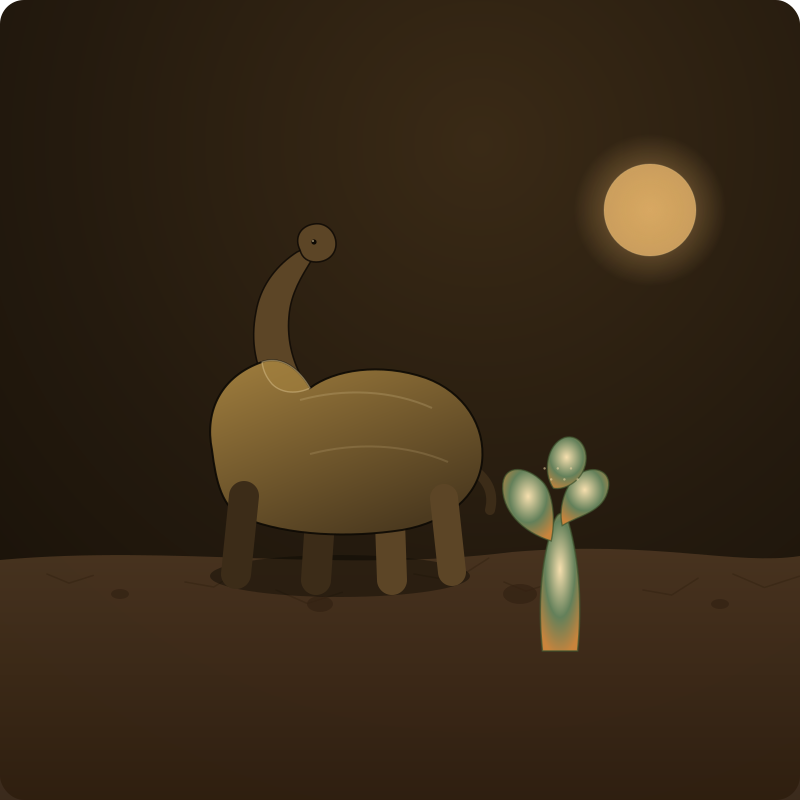
A giant tortoise of the volcanic Galápagos Islands, dome-shelled or saddle-shelled depending on which island shaped it, moving on a slow, patient walk that can outlast a century.
Everything this reading says about you is grounded in what the Galápagos Tortoise actually is: a reptile whose shell is quite literally built by the specific hardship of its home island, whose slow metabolism lets it survive a full year without food or water, and whose lifespan in the wild can run past a hundred years. This chapter is that foundation. The rest of the page draws its meaning from these real traits.
The shape was never a flaw to fix. The island simply asked something of you, and your body, patiently, said yes.
6 traits below
01of six
The saddleback rim
Galápagos tortoise populations differ by island: tortoises on wetter islands with abundant low vegetation grow rounded domed shells, while tortoises on drier islands with sparse, tall plants grow saddleback shells, cut away and raised sharply at the front so the neck can stretch almost straight up to reach cactus pads a domed shell would never allow.
The exact shape you carry was decided early, by whichever ground actually raised you, not by the ground you might have preferred. The reach was never something you asked for. The place you grew up on required it of you.
02of six
The stored year
Extremely low metabolic rates let Galápagos tortoises survive for up to a year without food or water, drawing on stored body fat and a water-storage sac near the bladder; the same trait was later exploited by 18th- and 19th-century sailing ships, which stacked live tortoises in their holds as a source of fresh meat that needed no feeding for months at sea.
A very long stretch runs on what you already stored, quietly, before anyone thought to check on you. It has never once occurred to the people relying on that endurance to ask what the emptiness actually cost you.
03of six
The century body
Galápagos tortoises are among the longest-lived vertebrates known, with wild individuals commonly documented living past 100 years and some captive individuals estimated well beyond 150, a lifespan researchers link in part to an unusually slow, steady growth rate rather than any single organ or gene.
Your growth was never going to be fast, and it was never supposed to be. What you are building is built to outlast the people watching you build it.
04of six
The island signature
In 1835, the acting vice-governor of the Galápagos told Charles Darwin that he could identify which island any tortoise had come from by the shape of its shell alone, an observation Darwin later cited among the evidence that shaped his early thinking on how isolated environments produce distinct forms.
Anyone who actually knows you can tell where you were formed just by looking at how you are built. The island rarely needs explaining. The shape already says it.
05of six
The morning sun
As ectotherms, Galápagos tortoises depend on external heat to become active, and are commonly observed basking in the early morning sun before beginning the day's slow travel to feed, a ritual that regulates body temperature and effectively sets the day's pace.
You need the right conditions before you move, and you refuse to fake readiness before they arrive. Once you are actually warm, nothing rushes the rest of the day.
06of six
The lowland-highland walk
On larger islands, Galápagos tortoises make seasonal migrations of several kilometers between lowland nesting and feeding grounds and cooler, wetter highland vegetation zones, with tracking studies documenting individuals returning to the same route year after year, timed to the rains rather than to any fixed calendar.
You keep a private route back to what actually feeds you, walked so many times it barely looks deliberate anymore. This is not wandering. It is being on schedule with something only you are tracking.