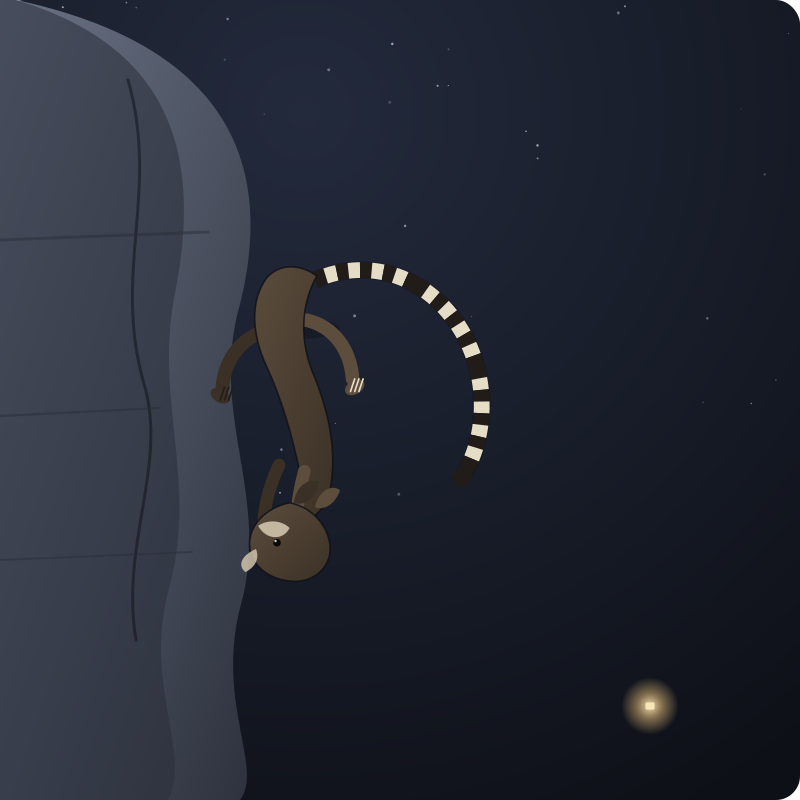
Meet the Ringtail
A creature that reverses its own feet, welcomed at every camp and claimed by none.
A small, fox-faced carnivore of North America's rocky deserts and canyons, more closely kin to the raccoon than to any cat, and built almost entirely around the night and the narrow ledge.
Everything this reading says about you is grounded in what the Ringtail actually is: a climber whose hind feet rotate backward to carry it headfirst down a cliff face, a nocturnal hunter with eyes built for full dark, and a small, self-sufficient tenant of old mining camps and desert canyons that was never actually domesticated. This chapter is that foundation. The rest of the page draws its meaning from these real traits.
The exit was never a rejection. It was the one thing that let it keep coming back.
6 traits below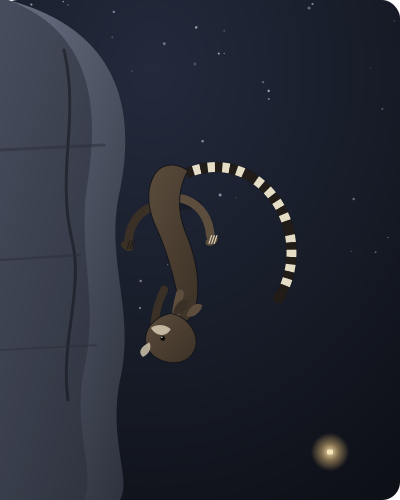
01of six
The reversed foot
The Ringtail's hind ankle can rotate more than 180 degrees, letting the pads and claws keep contact with the surface through a full headfirst descent of a cliff face, tree trunk, or narrow ledge.
Under pressure, your first instinct is not to freeze and look for a rope. It's to find a new angle and keep moving, the way a ringtail reverses its own grip mid-drop and turns a straight fall into a controlled, headfirst descent, using ground that would stop almost anyone else.
02of six
The counterweight tail
Its tail, ringed in fourteen to sixteen bands and about the same length as its own body, acts as a counterbalance on narrow ledges and thin branches, and the Ringtail can reverse direction on a slim foothold by cartwheeling around it.
You carry your own counterweight. When the ground under you narrows to almost nothing, you don't need a wider path, you need whatever you already brought with you.
03of six
The stemmed passage
To climb narrow vertical crevices too wide to bridge with a single stride, Ringtails stem, pressing their feet against opposite walls, or ricochet between them in wider gaps, ascending spaces with no obvious foothold at all.
Where other approaches see a dead end, you look for the two surfaces you can push against at once. You have gotten out of tighter spots than anyone watching gave you credit for, and you rarely explain how.
04of six
The unclaimed camp
During the 19th-century mining boom of the American Southwest, Ringtails moved into cabins and mine shafts to hunt the rodents drawn by stored food, and miners sometimes left them a warm box near the stove, giving rise to the name miner's cat, though no domestication or breeding of the species ever took place.
You will take the shelter that's offered and do real, valued work in return. What you have never done is become anyone's possession in exchange for it. The warmth was welcome. The ownership never was.
05of six
The concentrated water
Ringtails living in arid habitat can survive largely on water obtained from their food alone, aided by urine more concentrated than that of almost any other mammal studied, an adaptation that lets them go long stretches without a standing water source.
You have quietly figured out how to run on far less outside support than people assume you need. What looks like independence from a distance is mostly just excellent internal economy.
06of six
The solitary dark
Ringtails are strictly nocturnal and largely solitary outside the spring breeding season, navigating with large eyes and upright ears built for near-total darkness, and communicating largely through scent marks left at shared latrine sites rather than face-to-face contact.
You do your realest work when almost nobody is watching, and you leave a mark that tells the right people you were there without needing to be there when they read it.