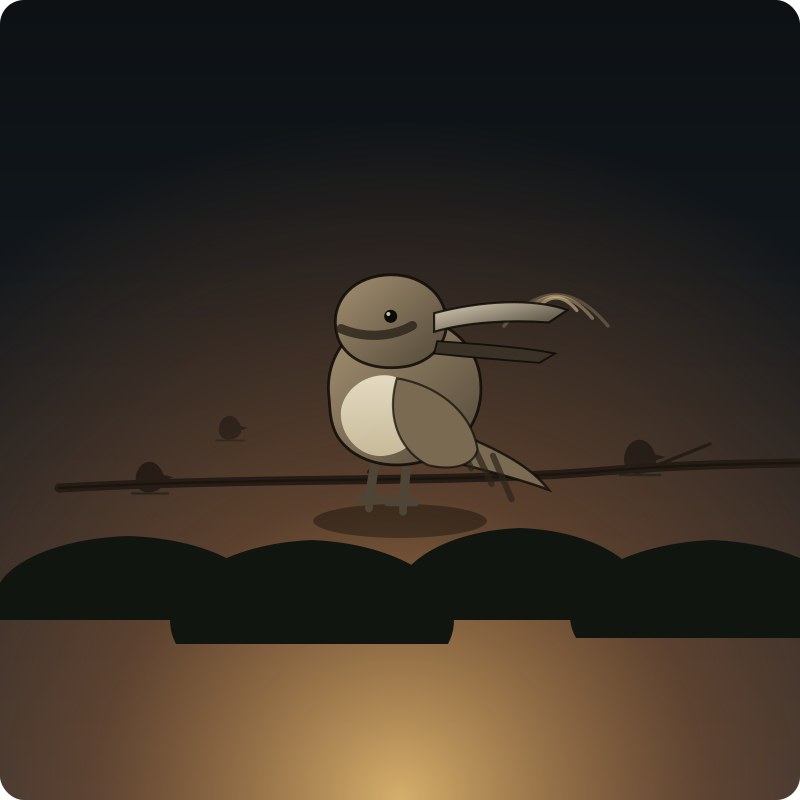
Meet the Kookaburra
A call built to sound like comedy, built to mean something else entirely.
The largest member of the kingfisher family, a heavy-beaked hunter of Australia's eucalypt woodland that spends almost none of its life anywhere near water.
Everything this reading says about you is grounded in what the Kookaburra actually is: a bird whose signature laugh is a territorial announcement performed by the whole family at dawn and dusk, a kingfisher that hunts almost entirely on solid ground, and a cooperative breeder whose own grown chicks stay on to raise the next brood. This chapter is that foundation. The rest of the page draws its meaning from these real traits.
The laugh was never the problem. What people assume it means is.
6 traits below
01of six
The dawn chorus
The kookaburra's rolling, cackling call functions as a territorial declaration performed communally by the whole family group, typically in a chorus at dawn and dusk, and is a learned behavior taught to young birds by the breeding pair rather than an instinctive sound.
It reads as entertainment to anyone passing underneath. Everyone in earshot who actually understands it hears a boundary being renewed, not a joke being told.
02of six
The ground hunter
Though classified in the kingfisher family Alcedinidae, the Kookaburra hunts almost entirely on land rather than fish, taking insects, frogs, small mammals, and reptiles, including snakes over a metre long, some of them venomous.
You were built for one thing and quietly became excellent at a different one. Most people still expect the version of you that matches the label, and miss what you're actually doing on the ground.
03of six
The strike
A kookaburra kills or subdues prey by gripping it in its beak and repeatedly striking it against a branch or the ground, aided by a bony ridge at the back of the skull and strong neck muscles built for the impact, before swallowing it whole, headfirst.
Once you commit to something difficult, you don't negotiate with it halfway through. You finish what you started, and finish it hard, the way a kookaburra won't release a catch until the strikes have actually stopped it moving.
04of six
The helpers
Kookaburras practice cooperative breeding: the breeding pair is typically joined by one or more auxiliary helpers, usually their own offspring from a previous year, who feed the nestlings and help defend the territory instead of leaving to breed on their own.
The people who once needed you to raise them are, for you, exactly the people who stay to help you raise the next ones. You build the family from who chose to stay, not just who was born into it.
05of six
The sparring match
Within a family group, kookaburras establish a dominance order through ritualized sparring, gripping bills and twisting until one bird yields the perch or flies off, a contest that rarely escalates beyond the display.
You settle rank the way your family does: briefly, physically, in full view, and then it's over. You would rather have one honest contest than a season of unspoken resentment.
06of six
The kept ground
A kookaburra pair occupies the same defined territory year-round, nesting in an unlined hollow they excavate into a living or dead tree, or bore directly into an aerial termite mound using the beak alone.
You don't look for new ground. You settle deeper into the one you've already chosen and make it impossible to dislodge you from, the way a kookaburra bores its nest straight into the tree it has already picked instead of hunting for an easier trunk. What looks like a lack of ambition is actually the decision already made, a long time ago.