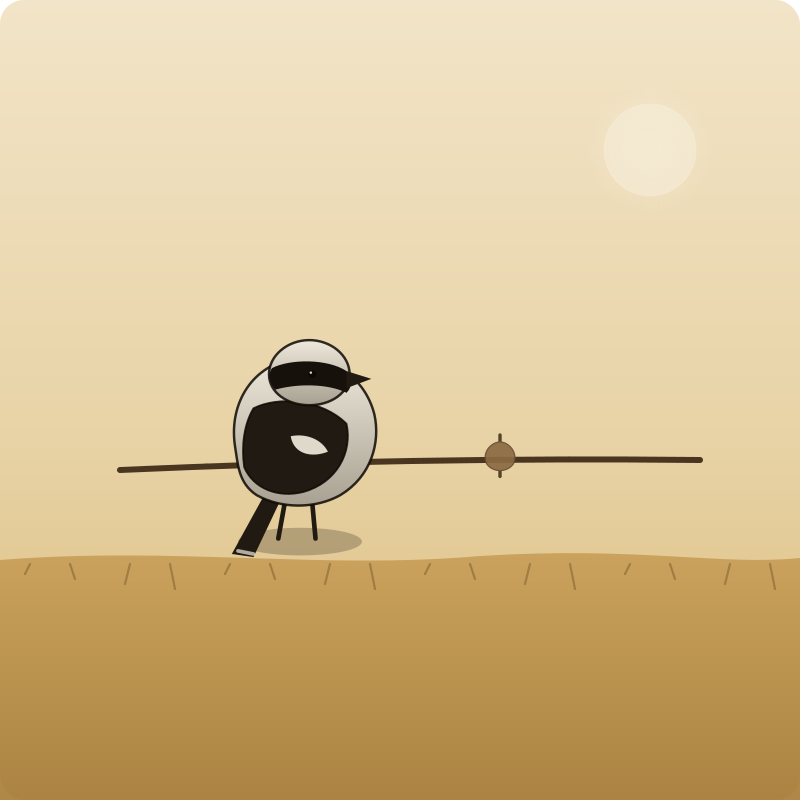
Meet the Loggerhead Shrike
A hunter's precision, carried in a body built for song.
A small gray-and-white songbird of North America's open country, hunting from fences and bare branches with a hooked bill built for work no ordinary songbird does.
Everything this reading says about you is grounded in what the Loggerhead Shrike actually is: a perching bird without a raptor's talons that kills like one anyway, impaling what it catches on thorns and barbed wire, storing it, and returning to it later. This chapter is that foundation. The rest of the page draws its meaning from these real traits.
The violence was never the secret. The stillness that comes before it is.
6 traits below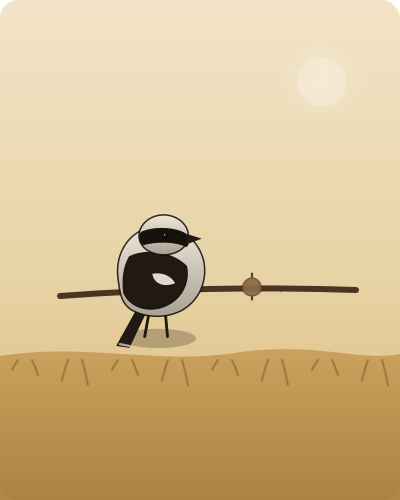
01of six
The hooked bill and the tomial tooth
The Loggerhead Shrike's hooked, black bill carries a pair of small pointed notches on its upper edge, called tomial teeth, which it uses to strike the back of a prey animal's neck and sever the spinal cord.
The exact point where a problem stops being complicated is what you find first, and you go there directly instead of working the whole surface of it. Once you locate it, you rarely need a second attempt.
02of six
The larder
The shrike impales insects, lizards, small rodents, and occasionally other birds on thorns, spines, or barbed wire, building a stockpile called a larder, which lets it store food, tear apart prey too large to hold with its feet, and let toxic prey sit until the poison breaks down.
Other people would have already let go of these things. You hold on, not out of sentiment but because you know exactly when each one will be useful, or safe, to use. Nothing you keep is kept by accident.
03of six
The larder as display
A well-stocked larder has been linked to greater breeding success in shrikes; in the closely related Southern Grey Shrike, females paired with better-provisioned males laid more eggs and raised more young than those paired with males storing less.
What you have quietly put away, the results, the receipts, the proof, ends up doing more to earn someone's trust than anything you could say about yourself. You let the evidence make the case.
04of six
No talons
As a true passerine, the Loggerhead Shrike has the small, gripping feet of a songbird, not a raptor's curved talons, and lacking the strength to pin prey down while feeding, it wedges its kill into a thorn or a barb instead and works from there.
Your strength was never in your hands. It's in finding the fixed point, the deadline, the commitment, that holds a thing steady long enough for you to finish it. You improvise the grip you weren't given.
05of six
The exposed perch
The Loggerhead Shrike hunts by day from a single exposed perch, a fence post, wire, or bare branch in open grassland or scrub, scanning the ground below and dropping in a short, direct flight once it identifies prey.
Clearest thinking, for you, happens out in the open, watching, before you've committed to anything. People read your stillness as passivity. It is the whole hunt, happening quietly.
06of six
Waiting out the poison
Loggerhead Shrikes have been observed impaling toxic prey, including monarch butterflies and toads whose skin secretes irritating compounds, and leaving them on the thorn for up to several days before returning to eat them, by which time the toxins have broken down.
There is a difference you know well: a feeling that's dangerous right now, and one that will be safe to handle later, and you are willing to just wait the second one out. You do not rush what needs time.