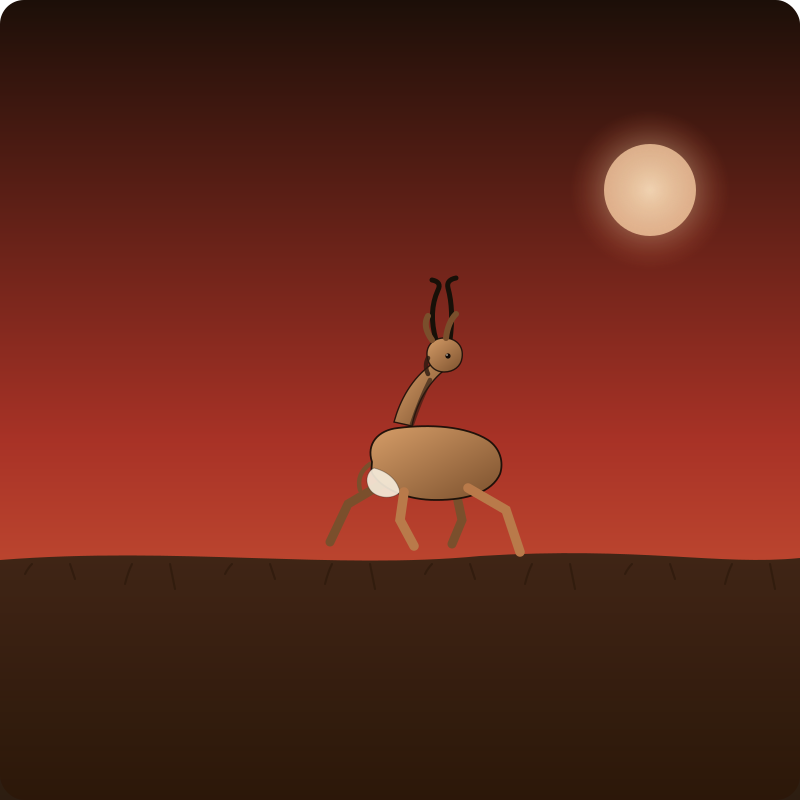
Meet the Pronghorn
The fastest land animal in the Western Hemisphere, still pacing itself for a predator gone ten thousand years.
A hoofed sprinter of the open grassland and high desert of North America, built by a predator that has not existed for ten thousand years.
Everything this reading says about you is grounded in what the Pronghorn actually is: an animal with the oversized heart and lungs to run at speed for miles rather than yards, eyes built to read a horizon most creatures cannot see the edge of, and horns that come off and regrow every single year. This chapter is that foundation. The rest of the page draws its meaning from these real traits.
The predator is gone. The running was never really about it.
6 traits below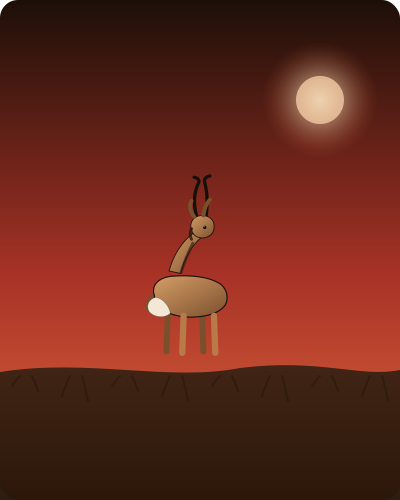
01of six
The impossible stamina
Where a cheetah can approach 70 mph but exhausts itself after a few hundred yards, the Pronghorn can hold roughly 45 to 55 mph across several miles and sustain around 30 mph for distances up to twenty miles, a stamina no living North American predator can match.
You are built to keep pace long after the moment that mattered has passed. Other people sprint. You are still running when their sprint would already have ended.
02of six
The engine built for a chase that ended
The Pronghorn's heart is proportionally around three times larger than a similarly sized domestic animal's, and its lungs carry roughly five times the surface area of a same-sized goat's, feeding a wide trachea built to move oxygen at speed.
You carry more capacity than most situations actually ask for. The size of what you can handle was set by something harder than what you usually face.
03of six
The horn that comes off
Alone among horned mammals, the Pronghorn sheds and regrows the outer keratin sheath of its horns every year, typically after the fall rut in males, leaving the bare bony core exposed before a new, branched sheath grows back in.
You do not wear the same armor twice. What looks fixed on you is, underneath, something you actually rebuild on a schedule.
04of six
The horizon that misses nothing
Large eyes set high and wide on the skull give the Pronghorn close to a 300-degree field of view without turning its head, sharp enough to register a moving object roughly four miles away.
You register a shift in the room before anyone else has named it. You were watching the horizon before you knew there was anything on it.
05of six
The flash the herd reads for miles
When alarmed, a Pronghorn erects the long white hairs of its rump patch, doubling its size into a flash of white visible to other pronghorn up to two miles away, a warning that spreads through the herd before the danger reaches most of them.
You signal danger before anyone has asked you to. The people around you have learned to watch you, not the horizon, for the first sign of trouble.
06of six
The wire it will not clear
Despite outrunning nearly everything on the continent, the Pronghorn is a poor jumper and, faced with a fence, will typically crawl underneath rather than leap over it, a gap left by a landscape that had nothing taller than sagebrush for millions of years.
Your old alarms know exactly what to do with a chase. They have no answer for an obstacle no predator ever taught you to clear.