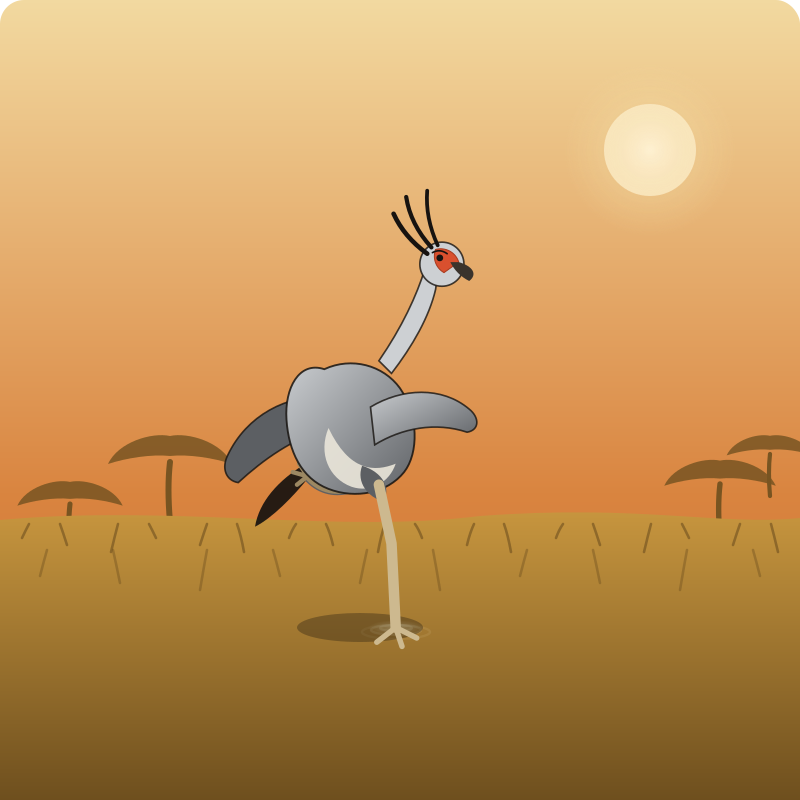
Meet the Secretary Bird
A composed, quill-crested walker carrying a killing stroke faster than a blink.
A tall, grey-feathered bird of prey that hunts almost entirely on foot across Africa's open savanna, a crest of long black quill-like plumes marking the back of its head.
Everything this reading says about you is grounded in what the Secretary Bird actually is: a raptor that walks down its prey instead of diving on it, closes on venomous snakes with a downward kick faster than the eye can follow, and returns every dusk to a nest it has kept for years. This chapter is that foundation. The rest of the page draws its meaning from these real traits.
The calm was never a performance. The stomp was always the point.
6 traits below
01of six
The stomp
Secretary birds kill prey, including venomous snakes, with rapid downward kicks measured at roughly 195 newtons of force, about five times the bird's own body weight, delivered in a contact time of around fifteen milliseconds, fast enough that researchers needed a force plate and high-speed cameras to study the strike properly.
The force you can bring to bear rarely shows in how you carry yourself day to day. When it finally arrives, it arrives finished, not building.
02of six
The long walk
Secretary birds hunt almost entirely on foot on long, crane-like legs, covering up to 20 to 30 kilometres a day across open grassland in search of prey, one of only two raptor species that hunts mainly by walking rather than from the air.
You do the actual work of finding what you are after on the ground, step by step, long before anyone sees the moment it pays off. The distance is where the decision gets made, not the strike.
03of six
The quill-crest
Long, black, quill-like feathers project from the back of the Secretary Bird's head, a plume early naturalists compared to a clerk's writing quill tucked behind the ear, and it is the likely source of the bird's common name.
There is a formality to you that reads as clerical, orderly, almost administrative, sitting directly on top of an instinct built for something far less tidy, the way a Secretary Bird wears a plume like a clerk's quill right above a body built to kill. People clock the paperwork look long before they clock what it is actually sitting on.
04of six
The lashes at the strike
Stiff, thickened feathers resembling eyelashes, known as rictal bristles, ring the Secretary Bird's eyes and are thought to shield them from dust and struggling prey during the kick, protecting the one part of the bird most exposed in the instant it is doing the most damage.
You protect what is most vulnerable in you at the exact moment you are being the most decisive. The softness does not disappear when you act. It just moves somewhere safer to keep.
05of six
The nest built to last
Largely monogamous pairs build a huge stick nest atop an acacia or thorn tree and reuse and add to it across many breeding seasons, until a long-held nest can measure roughly 2.5 metres across and weigh close to a metric ton.
What you commit to, you keep adding to rather than replace. Anyone watching the growing weight of it over the years is watching a decision you made once, still being kept.
06of six
The evening return
Despite hunting almost entirely on the ground by day, Secretary birds fly up to roost in the same treetop nest every night at dusk, trading the open grass for a fixed, elevated perch until first light.
However far you range in a day, you go back to the one place that already knows you. The ground is where you work. The height is where you actually rest.