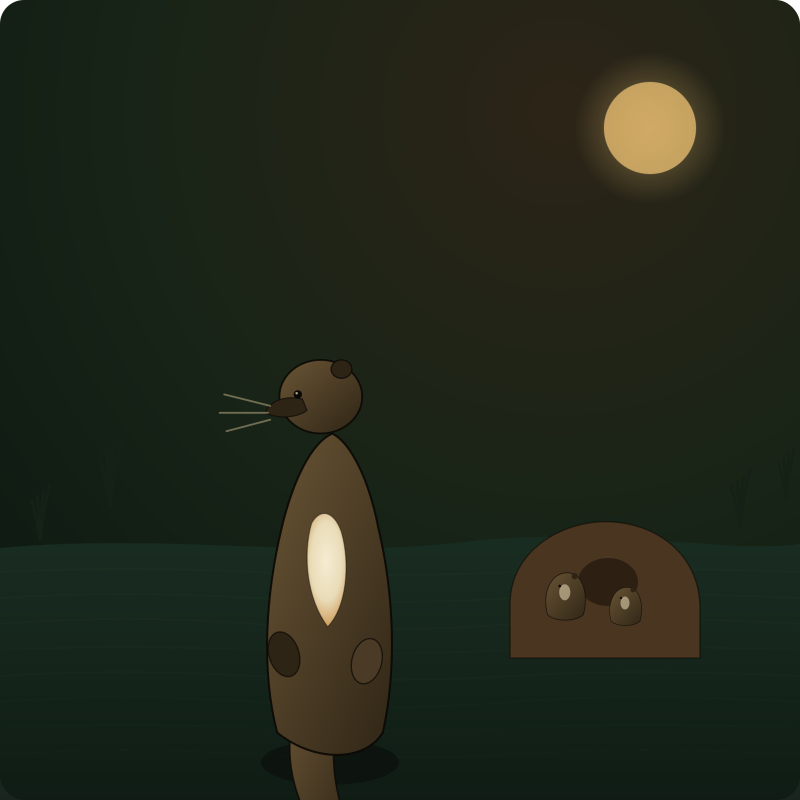
Meet the Giant Otter
The loudest family on the river, and the fiercest one once the den is threatened.
The largest otter on Earth, a river predator of the Amazon and Orinoco basins that hunts, rests, and raises its young inside one loud, inseparable family group.
Everything this reading says about you is grounded in what the Giant Otter actually is: the longest member of the weasel family, a creature with one of the widest vocal ranges of any otter species, an animal that marks the same stretch of riverbank for years, and a family that will turn on a predator many times its size the moment a pup is threatened. This chapter is that foundation. The rest of the page draws its meaning from these real traits.
The volume was never the problem. What you do when it goes quiet is.
6 traits below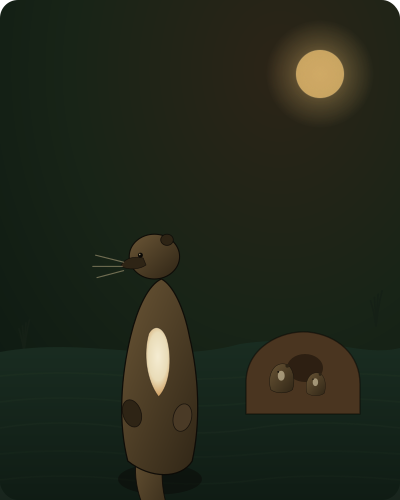
01of six
The throat patch
Each Giant Otter carries a patch of cream to white fur on its throat and chest, unique in shape and pattern to that individual, and researchers identify wild otters from photographs of it much the way whales are tracked by a fin.
You carry an identity that does not blend into the group, even inside a family this close. People can pick you out of a crowd without needing you to say a word.
02of six
The twenty-two calls
Adult Giant Otters use at least 22 distinct vocalization types, recorded separately for contexts including alarm, contact, and aggression, each used in its own situation rather than interchangeably.
What you feel rarely gets reduced to one noise. You have a different sound, a different word, a different tone for the alarm than for the welcome home, and you expect the people close to you to hear the difference.
03of six
The chorus
When a family senses an intruder or a predator, several members vocalize together in a synchronized group chorus, and studies have found each family's chorus carries an acoustic signature distinct enough to identify the group.
Your alarm is rarely a solo. When something threatens what you love, you are not the only voice that rises. You have built a family that sounds like one animal when it matters.
04of six
The periscope
A Giant Otter will rise chest-high out of the water, head lifted above the surface, both to look for danger over the reeds and to show its throat marking to other otters nearby.
The same posture that lets you check for danger is the posture that shows everyone exactly who you are. In you, being on guard and being visible are the same motion.
05of six
The marked bank
Family groups clear and repeatedly use the same riverbank campsites and communal latrines, some over 25 meters long, scent-marking them with urine and musk to hold a territory against neighboring families.
You return to the same ground and the same people on purpose, again and again, not because nothing has changed but because the return itself is how you keep the claim current.
06of six
The mobbing
A lone otter will rarely challenge a much larger predator, but a family will collectively attack and can kill a caiman several times the size of one otter if it threatens a pup, working the animal in coordinated turns.
Alone, you would not pick this fight. Inside the family, the math changes completely, and you become willing to do things no single version of you would attempt.