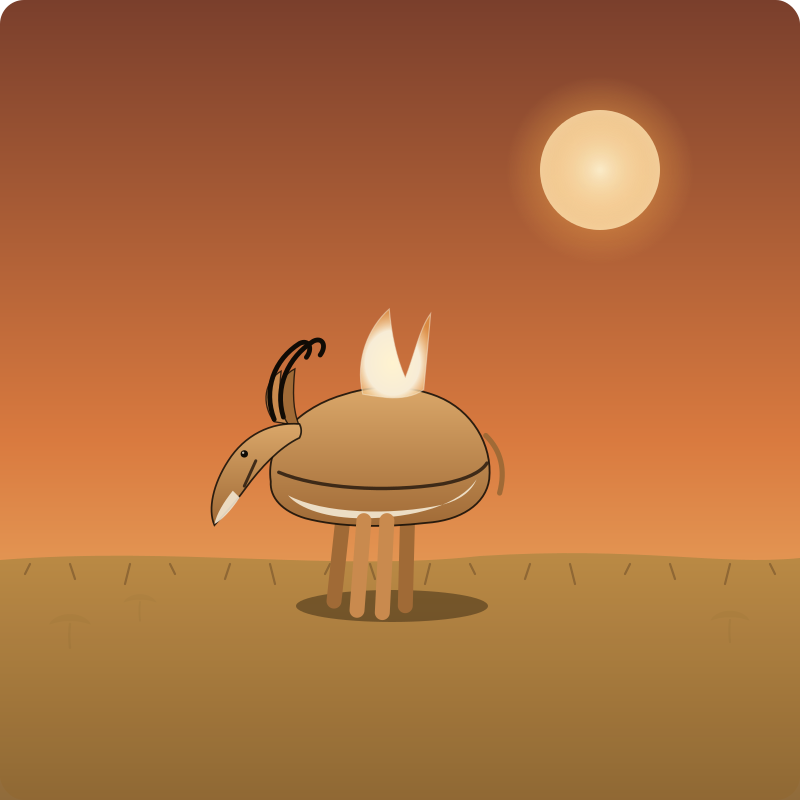
Meet the Springbok
A full display of strength, performed exactly when hiding would make more sense.
A small, fast antelope of southern Africa's dry grassland and semi-desert, marked by a white face, a dark flank stripe, and a fold of skin along its back that opens only when it moves.
Everything this reading says about you is grounded in what the Springbok actually is: a herd animal built for open, coverless ground, with a defense that shows itself in full rather than hiding, and a body tuned equally for a short, explosive burst and a long season without water. This chapter is that foundation. The rest of the page draws its meaning from these real traits.
The leap was never about escape. It was always about being seen clearly enough that nothing bothered to give chase.
6 traits below
01of six
The pocket
A fold of skin runs from the middle of the springbok's back to its rump and opens along a groove in the spine, lifting a fan of long white hairs whenever the animal pronks. The fold is the source of the species name marsupialis, Latin for pocket.
You keep a part of yourself folded closed for most of the day, and you know exactly which moment is worth opening it for. When it opens, it opens completely, not partway.
02of six
The pronk
In a pronk, the springbok leaps with all four legs held stiff and off the ground at once, head down, back arched, hooves drawn in close beneath it, and repeats the bound several times in a row rather than sprinting away outright.
Your first move under real pressure is rarely to run. It is to show, plainly and more than once, exactly how much strength you are holding in reserve.
03of six
The burst
A springbok can reach roughly 88 kilometers per hour in a short sprint and hold near 50 kilometers per hour over about six kilometers, speed drawn from fast-burning muscle fuel rather than long endurance.
What you carry is not built to be rationed out. It spends itself completely, exactly when it is needed, and asks nothing of you for hours on either side of that moment.
04of six
The dry season
Springbok can go extended periods without drinking, drawing most of the moisture they need directly from the leaves, shoots, and succulent plants they graze, even through long stretches of drought.
You have learned to run for longer than people assume, on less than they think you're getting. A dry season rarely shows on you until someone finally asks how long it's been.
05of six
The trekbok
Before fencing and farmland reshaped the region in the late 1800s, springbok formed trekbokken, seasonal mass migrations that could number in the millions and take days to pass a single point, moving as one continuous herd toward wherever the rain had fallen.
Some part of you still expects to move with a far larger crowd than the one currently around you, and travels light for exactly that reason.
06of six
The lyre horns
Both male and female springbok grow ringed, black, lyre-shaped horns, typically 35 to 50 centimeters long, unusual among African antelope, where horns are more often carried by males alone.
You do not keep your defenses for a version of yourself dressed for a fight. They stay plain and in the open, whether or not you ever plan to use them.