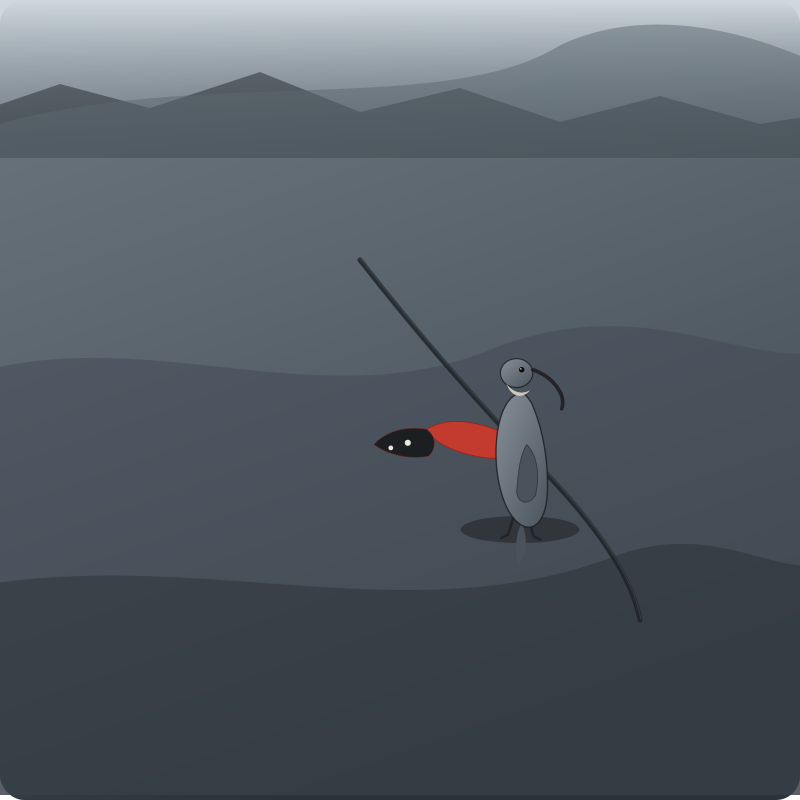
Meet the Wallcreeper
A flutter built like a butterfly's, spent entirely on the hardest rock in the range.
A small grey bird of the high Eurasian mountains, found nowhere but bare cliffs and gorges, working cracks in rock that almost nothing else can reach.
Everything this reading says about you is grounded in what the Wallcreeper actually is: a bird that forages alone on sheer rock, flashes a hidden crimson only while it works, and holds its own patch of stone through a whole winter with no flock around it. This chapter is that foundation. The rest of the page draws its meaning from these real traits.
The color was never the problem. Only showing it mid-labor is.
6 traits below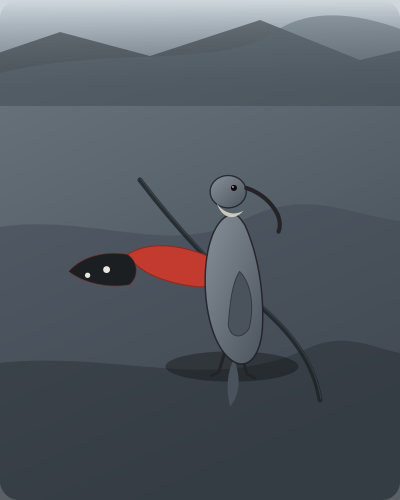
01of six
The vertical wall
The Wallcreeper forages almost entirely on sheer, near-vertical cliff faces and gorge walls, moving across the rock in short hops and flutters rather than settling to feed.
The steepest part of a problem is where your hardest work happens, standing up, rarely sat down with. Once you have found the wall no one else wanted, you are already on it.
02of six
The wing-flick
As it works a rock face, the Wallcreeper flicks its wings half-open in a near-constant motion, briefly exposing crimson-and-black patches otherwise hidden against its grey plumage, a habit that has earned it the nickname "the butterfly of the crags."
Your brightest color does not come out to be admired. It comes out while you are working, and disappears the moment you stop.
03of six
The one crooked bill
A slender, downward-curved bill lets the Wallcreeper probe cracks and fissures in bare rock for insects and spiders, a food source almost no other bird in its range is built to reach; it is the only living member of its own family, Tichodromidae.
Shaped for the kind of problem other people walk past, because they were never built to open it, you do not compete for the gap. You are simply the only one who fits it.
04of six
The solitary winter
Outside the breeding season the Wallcreeper remains largely solitary, with males and females each holding and defending an individual feeding territory, and birds have been shown to return to the same winter stretch of rock in consecutive years.
Company is not what you go looking for once the season's real work starts. You go back to the same hard ground, alone, because you already know it will hold you.
05of six
The bare, high line
The Wallcreeper breeds at elevations between roughly 1,000 and 3,000 metres, on cliffs and gorges that sit at or above the treeline, and descends no further than about 400 to 800 metres even in winter.
Ground that offers no cover and very little comfort is where you stay, in every season, because the exposure is the price of a wall nothing else is fighting you for.
06of six
The small body, the huge wall
An adult Wallcreeper measures around 15.5 to 17 centimetres and weighs 15 to 20 grams, a small bird set against rock faces that can run for hundreds of metres unbroken.
What you are up against is rarely in proportion to what you look like from a distance. Being large was never something you needed, for the wall to eventually be worked.