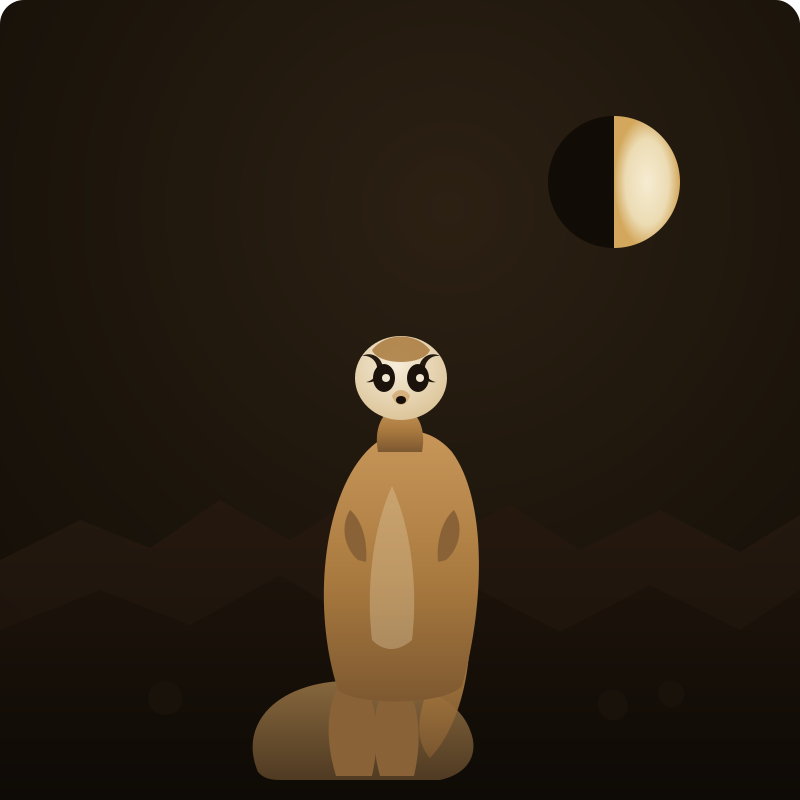
Meet the Meerkat
A forager's hands and a sentinel's eyes, running on the same small body.
A small mongoose of the Kalahari and the Karoo, standing on its hind legs atop a sunlit mound while the rest of its mob digs through the sand around it.
Everything this reading says about you is grounded in what the Meerkat actually is: a forager that keeps a rotating sentinel on watch at all times, an alarm system with a different call for every kind of danger, a den-builder that never relies on a single door. This chapter is that foundation. The rest of the page draws its meaning from these real traits.
The watch was never the problem. What you do with the hours off duty is.
6 traits below
01of six
The high sit
While the mob digs for food with its head down, one meerkat, often an older subordinate male, breaks off to take the high sit: raised fully onto its hind legs on a mound or termite hill, watching rather than eating, for a shift that rotates through the group.
You are rarely the one who forgets to look up. Some part of you is always standing at the edge of the room, even on the days you came only to eat.
02of six
The two alarms
A meerkat's alarm call changes shape depending on the threat: one call warns of a hawk or eagle overhead, a different one warns of a jackal or snake on the ground, and the call's urgency itself scales with how close and how fast the danger is moving.
You do not sound one alarm for every problem. You already have a different voice for the danger overhead and the danger at your feet, and the people who know you can tell them apart before you finish the sentence.
03of six
The babysitting shift
When most of the mob leaves to forage, one or more non-breeding adults, not necessarily the pups' own parents, stay behind at the den to guard and feed the young left in the burrow.
Care, for you, is not limited to your own. You will hold the door for someone else's responsibility as naturally as your own, and rarely make a ledger of it.
04of six
The many-doored den
A meerkat's burrow system has multiple entrances, some angled around forty degrees into the ground, and its underground chambers run roughly thirty degrees cooler than the desert air above; a single mob keeps several such burrow systems across its home range, never trusting its safety to just one door.
You rarely build your life around a single way out. You keep more than one door standing open, quietly, long before you need any of them.
05of six
The daylight eye
A meerkat's retina is made almost entirely of cone cells, giving it sharp color vision and a long, horizontally elongated pupil built for scanning open ground, but it comes at a cost: meerkats see poorly after dark and lose most of their advantage once the sun goes down.
Your clarity has a season. You read a room with total precision in the right kind of light, and you are the first to admit that some hours are simply not yours to see by.
06of six
The stand that grows taller
Facing a ground predator, a meerkat's fur rises, its back arches, and its legs straighten until its whole small body reads as larger than it is; and when the mob numbers more than about four, it will turn and mob the threat together rather than scatter.
Alone, you make yourself look larger than you feel. With enough of your own people beside you, you stop bluffing and simply turn to face it.