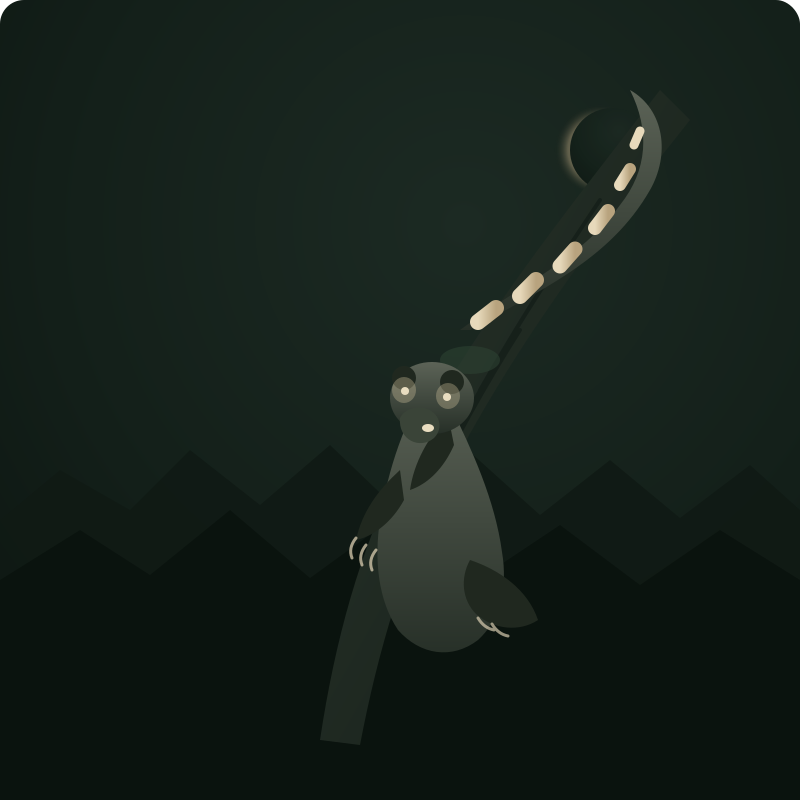
Meet the Cacomistle
An animal common across two countries of forest, and still one of the hardest mammals in it to actually confirm.
A slender, cat-faced relative of the raccoon that spends its whole life in the cloud-forest and rainforest canopy of southern Mexico and Central America, one storey above the ground it almost never touches.
Everything this reading says about you is grounded in what the Cacomistle actually is: a genuinely common animal that stays almost entirely unconfirmed, a climber built to reverse direction completely without losing its grip, and a solitary forager that still calls out across the dark for hours at a stretch. This chapter is that foundation. The rest of the page draws its meaning from these real traits.
The distance was never the problem. Being the only one who kept an accurate count of yourself was always the point.
6 traits below
01of six
The uncounted resident
The IUCN Red List classifies the cacomistle as Least Concern, describing it as locally common across the northern part of its range, yet field surveys of its own forest routinely record it as one of the least-detected mammals present, cryptic behavior rather than true scarcity.
You are the kind of present that never quite shows up on anyone's count. People who actually know you swear you are around constantly; people compiling the official record insist you are barely there. Both of them are describing the same forest correctly.
02of six
The missing floor
Nocturnal and highly arboreal, the cacomistle almost never comes down to the ground, moving through cloud-forest and rainforest canopy from sea level up to 2,000 metres.
Your whole life happens one storey above where people are looking. It is not hiding, exactly. It is simply that the ground was never where you actually lived.
03of six
The reversible descent
Climbers in the cacomistle's own genus can rotate the hind foot nearly 180 degrees, letting the pads and claws keep their grip while the whole body descends a trunk headfirst.
You can reverse a direction completely without losing your hold on anything. Most creatures back down carefully from what they climbed; you simply turn around and come down facing it.
04of six
The half-true name
The name cacomistle comes from the Nahuatl tlacomiztli, roughly "half mountain lion," a description of its cat-like agility despite belonging to the raccoon family and having no closer relation to any actual cat.
You were named for what you resemble, not for what you are. People reach for the nearest familiar animal to explain you and end up with half of a description, which is usually as close as anyone gets.
05of six
The counterweight tail
The bushy, boldly ringed tail runs 390 to 530 millimetres, nearly as long as the 380 to 470 millimetre body, and works as a counterweight and balance aid through fast, high branches.
Half of your visible length is the part that keeps the other half from falling. What people notice first, the flash of black and pale rings, is doing the quiet work of holding the rest of you steady.
06of six
The hours-long call
Solitary outside the mating season, cacomistles hold territories that can run past 130 hectares and exchange loud calls with neighboring individuals, sometimes for hours at a stretch, believed to mark the edges of that ground.
You keep your own ground and still talk across it for hours, to someone you may never actually stand next to. Solitude, for you, has never meant silence.