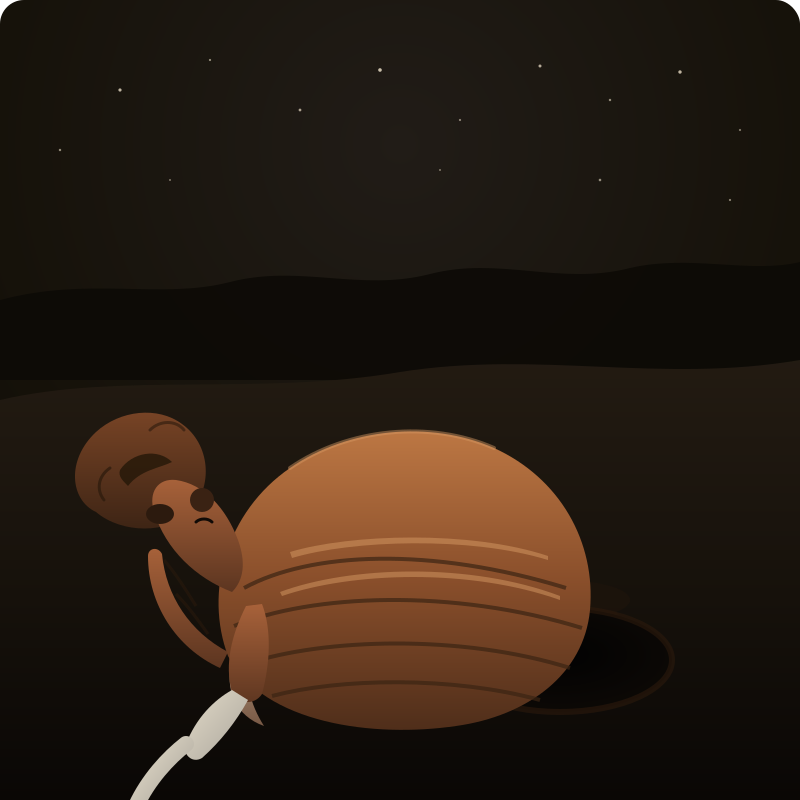
Meet the Giant Armadillo
Structurally necessary to a forest that will never learn her name.
The largest living armadillo, built around one enormous digging claw, moving alone through the termite mounds and river forests of South America after the sun is down.
Everything this reading says about you rests on what the Giant Armadillo actually is: an animal that can weigh over 30 kilograms and reach close to a meter of body length, carries a curved central claw built for tearing into a termite mound faster than the termites can defend it, and forages completely alone through a home range it may keep for years without ever building the same shelter in it twice. This chapter is that foundation. Everything after it draws its meaning from these real traits.
She was never hiding. She was already three rooms further on.
6 traits below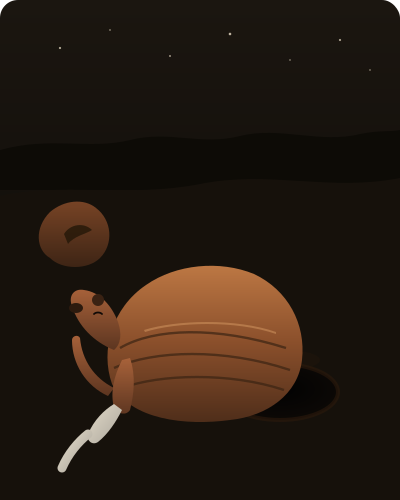
01of six
The blade at the end of the arm
The giant armadillo carries one greatly enlarged central digging claw, comparable in form to the great claw of the giant anteater, used to tear open termite and ant mounds and to excavate burrows in hard ground.
You have one instrument you trust completely to open what everyone else has to work around. Once it is in your hand, the shape of the problem stops being the obstacle.
02of six
The armor that does not close
Unlike most other armadillo species, the giant armadillo cannot fully enclose its body within its own carapace when threatened; its real defenses are size, its claws, and rapid digging, not sealing itself inside its shell.
What looks like your protection was never actually the plan. When it matters, you do not seal up. You move, dig, or stand your ground, and the armor was mostly for show.
03of six
The company of one
Giant armadillos are solitary and largely nocturnal, foraging alone through the night and coming near another of their kind almost exclusively to mate.
Most of your real hours happen with nobody else in the room. You have never needed an audience to work at full strength, and you are sometimes surprised when someone assumes you did.
04of six
The rooms she does not stay to see used
Once a giant armadillo has torn open and emptied a mound, it will sometimes bury itself beneath the remains and rest there for up to 24 hours before moving on, leaving the burrows and cleared ground it makes to be used afterward by other species entirely; researchers describe the species as a keystone species for exactly this reason.
Something you built with your own hands is, right now, keeping someone you will never meet warm, fed, or hidden. You were not there for it. You were already somewhere else, digging.
05of six
Reading the ground, not the light
Giant armadillo eyesight is poor; the strongest sense available to the species is smell, which does most of the real work of finding food and moving safely through the dark.
You have trusted a feeling you could not yet explain over something you could plainly see, and it has usually been the better information. You read the ground before you read the room.
06of six
One, rarely two
Giant armadillos typically give birth to a single offspring, occasionally two, after roughly a four-month gestation, and the young stay only with the mother, reaching independence at around six months old.
What you actually let grow close to you tends to be rare, singular, and entirely on your own timeline. You have never mistaken quantity for the real thing, and you have paid for that standard more than once.