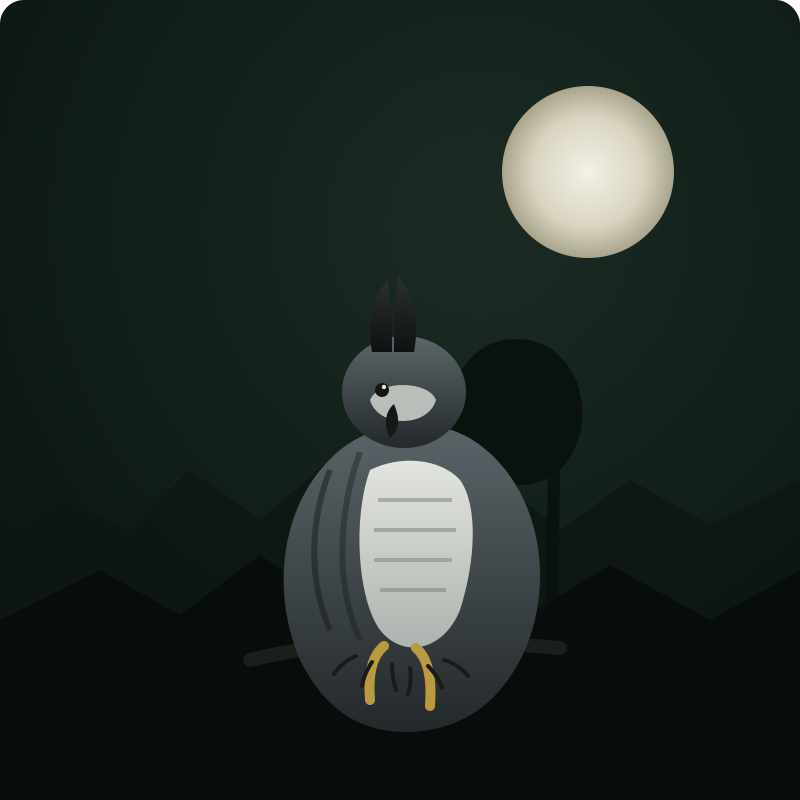
Meet the Harpy Eagle
The largest eagle in the world, and the last thing the canopy hears move.
The largest eagle in the Americas, built to hunt inside the rainforest canopy rather than above it.
Everything this reading says about you is grounded in what the Harpy Eagle actually is: an eagle too heavy and short-winged to soar the way its relatives do, built instead for total stillness and a single decisive strike through dense forest cover, and increasingly rare because the tall trees it depends on keep disappearing. This chapter is that foundation. The rest of the page draws its meaning from these real traits.
The size was never the problem. What it does with its stillness is.
6 traits below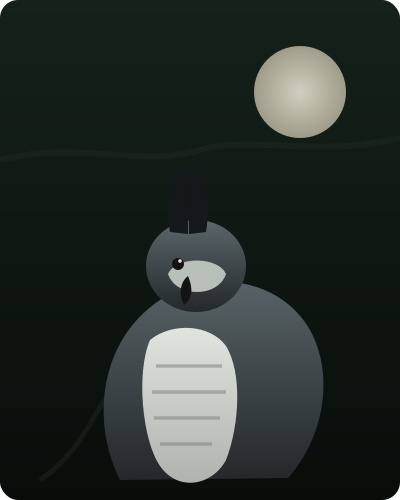
01of six
The crown
A double row of dark feathers rises from the back of the crown when the bird is alert, a raised crest with a longer, two-pointed shape that is one of the field marks separating an adult Harpy Eagle from the similar Crested Eagle.
Your alertness has a visible shape. When something changes in the room, the part of you paying attention rises where people can actually see it.
02of six
The talons
The Harpy Eagle's talons can reach up to 12.5 centimetres long, among the largest of any living eagle, carried on legs powerful enough to subdue prey many times heavier than the bird's own reach would suggest.
What you are capable of holding onto is not measured by how much of you shows on the surface. Most of it stays hidden until the grip actually closes.
03of six
The waiting
A solitary hunter, the Harpy Eagle can perch motionless for extended periods, reportedly up to 23 hours, scanning for arboreal prey such as sloths and monkeys, and it hunts by maneuvering through dense forest cover rather than soaring in open sky.
Your patience is not passive. It is a working stillness, spent scanning rather than resting, and it ends the moment the one thing worth moving for finally shows itself.
04of six
The throne tree
Breeding pairs build enormous nests, roughly 1.2 metres thick and 1.5 metres across, high in a tall tree, and these nests are reused by the same pair year after year rather than rebuilt from scratch each season.
You do not treat commitment as disposable. Once a place or a person has been chosen, you keep returning to it, adding to what is already there instead of starting over somewhere new.
05of six
The one chick
A female lays up to two eggs, but the pair raises only a single chick, which fledges around six to seven months and stays under parental care for about ten months total, well after it first leaves the nest, with pairs breeding only once every two to three years.
What you protect gets the whole of you, for as long as it actually takes, and you are in no hurry to divide that attention a second time.
06of six
The territory
Adult Harpy Eagles hold and actively defend a home range of roughly 30 square kilometres, driving out competing individuals, and mated pairs remain bonded for life, rebuilding their connection each season by working the nest together.
Your ground is not negotiable, and neither, once it is settled, is who you have chosen to hold it with.