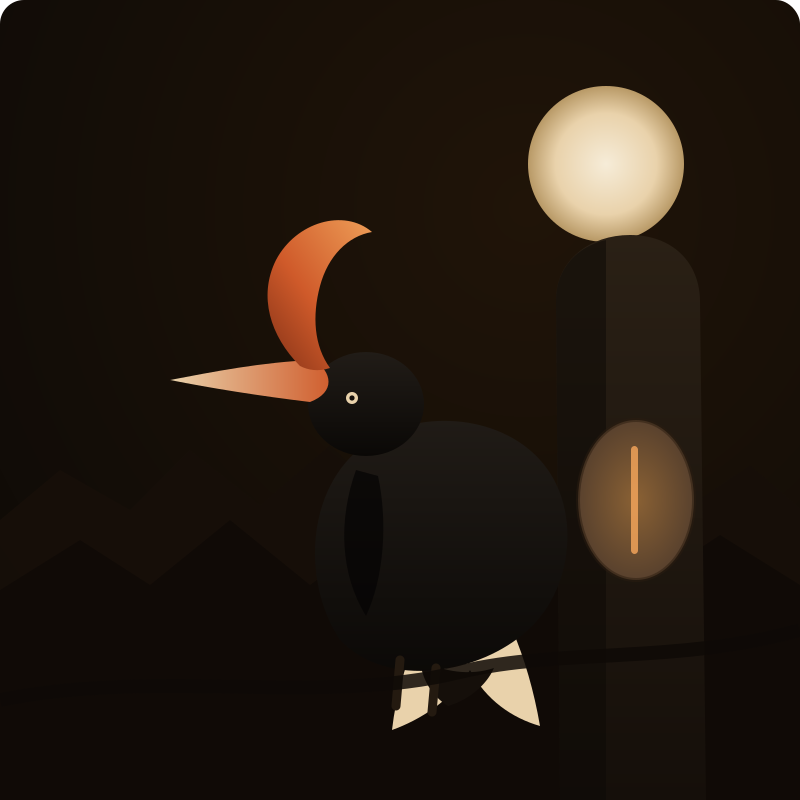
Meet the Rhinoceros Hornbill
The loudest bird in the canopy, walled into silence for the one nest that matters.
A hornbill of Southeast Asia's old-growth rainforest, carrying a bright upcurved casque above a bill built loud enough to fill the whole canopy.
Everything this reading says about you is grounded in what the Rhinoceros Hornbill actually is: a bird that stains its own signature color into being through daily preening, a mate that seals its most vulnerable season behind a wall it built itself, and a voice amplified by a hollow chamber in its own skull. This chapter is that foundation. The rest of the page draws its meaning from these real traits.
The casque was never the problem. What you choose to wall behind it is.
6 traits below
01of six
The stained casque
The bill and casque are naturally pale, but oil from the uropygial gland is worked into the feathers and rubbed onto the bill and casque during preening, staining them the deep orange-red the bird is known for.
The color everyone reads as yours from a distance was never given. It is renewed by your own hand, in private, on a schedule no one else sees.
02of six
The resonating chamber
The casque is largely hollow, and researchers believe it may function as an acoustic resonating chamber that amplifies the bird's loud, far-carrying calls.
What you say does not stay the size you said it. Something built into your own structure turns an ordinary sound into one that finishes the trip across the canopy.
03of six
The one call answered
Rhinoceros hornbills select a mate through duet calling and a head-raised display, and once paired, they are monogamous and typically remain with that mate for life.
You do not keep auditioning after the answer arrives. You call once, at full volume, in front of the whole forest, and then you stop calling elsewhere.
04of six
The sealed cavity
Before laying, the female enters a narrow tree hollow, and the pair seals the entrance behind her with mud, droppings, and fruit pulp, leaving only a narrow slit for her mate to pass food through.
You will wall yourself into the most important room of your life with your own materials, and trust one voice on the other side to still find the seam.
05of six
Thirteen trips a day
While his mate and chicks remain sealed inside, the male is solely responsible for provisioning them, sometimes delivering food through the slit as many as thirteen times in a single day.
Once you have agreed to feed something, you stop counting the trips. You just keep making them, on a schedule nobody has to remind you of.
06of six
The trees that need you
Certain large-seeded rainforest trees rely almost entirely on hornbills for dispersal, since few other animals in the forest are large enough to swallow the seed whole and carry it elsewhere.
Some things in your circle are only still growing because you were the one built to carry them that far. Nobody else present could have done that part.