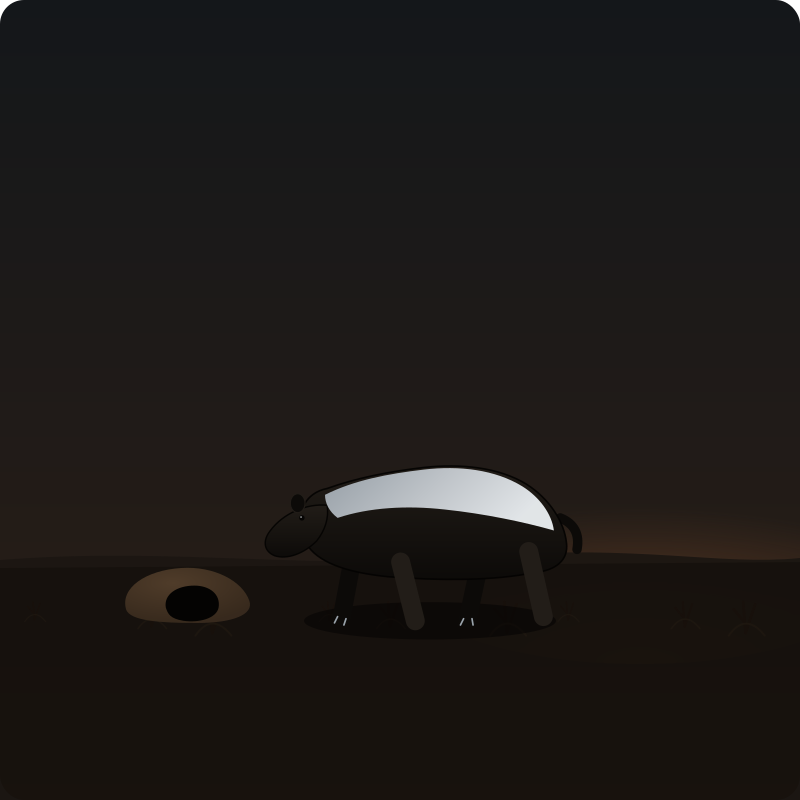
Meet the Honey Badger
A body built to survive the bite, driven by an appetite too stubborn to leave a meal unfinished.
A stocky, low-slung mustelid of Africa and parts of Asia, silver-maned and black-bellied, that walks into more danger in a day than most predators risk in a year.
Everything this reading says about you is grounded in what the Honey Badger actually is: a body wrapped in skin loose enough to twist inside a predator's jaws, a metabolism that can absorb venom that would kill most mammals its size, and an appetite wide enough to include the animals that just tried to kill it. This chapter is that foundation. The rest of the page draws its meaning from these real traits.
The fearlessness was never the trick. The body built to survive it was.
6 traits below
01of six
The loose hide
The skin around the honey badger's neck and shoulders is notably thick and loosely attached to the body, giving it enough slack to twist inside a grip, even a predator's jaws, and bite back.
A tight grip rarely means the fight is over for you. You keep just enough slack in a bad situation to turn before whoever caught you has finished deciding they have you, the way a honey badger goes loose inside a predator's jaws until there is room enough to twist and bite back.
02of six
The bite it walks away from
Honey badgers have been documented surviving bites from venomous snakes, collapsing as though dead for a period before reviving; research has linked this resistance to mutations in a receptor that many neurotoxins target, mutations found convergently in honey badgers, pigs, and hedgehogs.
Something in you can go down hard and still get back up on its own schedule. You have learned not to trust the first verdict on whether you're finished.
03of six
The dug room
A powerful, fast digger, the honey badger excavates its own burrows, commonly up to about three metres long and a metre and a half deep, and also readily takes over dens already dug by aardvarks, foxes, and other animals.
Self-made shelter is the shelter you trust. You would rather build what you need than wait for someone to hand you space, though you're not above moving into a good setup someone else already built, the way a honey badger digs its own burrow but just as happily takes over one an aardvark left behind.
04of six
The wide, repeated ground
Honey badgers are largely solitary with very large home ranges, recorded up to roughly 500 square kilometres in parts of the Kalahari, and an individual can cover 20 to 30 kilometres in a single day moving between den sites.
No single fixed point holds you. You keep a wide loop of ground and people you return to, on your own route, the way a honey badger works the same rotation of burrows across a range too large for anyone else to map.
05of six
The unfussy appetite
An opportunistic carnivore, the honey badger has been recorded eating more than sixty different prey species, from scorpions and insect larvae to snakes, rodents, and birds' eggs; the popular image of it constantly raiding wild bee nests for honey is more folklore than documented habit, though it will take a hive when one is actually found.
What you're known for is rarely what actually feeds you. The reputation is one good story; the real diet is decades of unglamorous, opportunistic work.
06of six
The schedule that moves with the risk
Activity patterns shift by pressure: honey badgers in areas with little human disturbance are often active by day, while populations living alongside people become largely nocturnal, adjusting when they move to when it is actually safest to move.
Courage does not run on a fixed clock for you. You read the real risk in a place and move when it is genuinely safer to, not when it looks best, the same way a honey badger trades day for night the moment people start showing up.