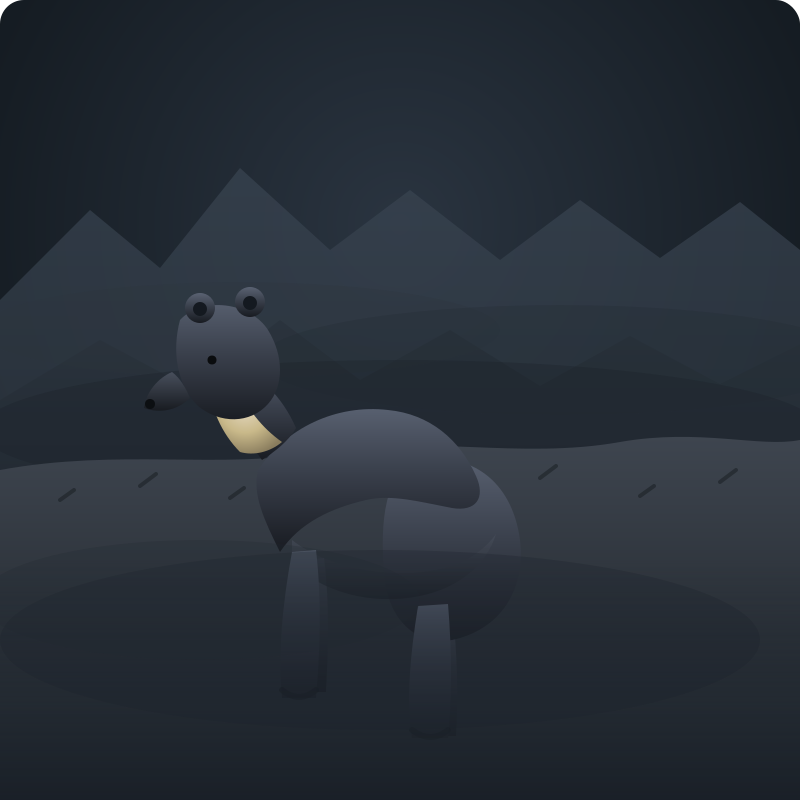
Meet the Tibetan Blue Bear
A bear so rarely seen that for decades even the people who study bears half-treated it as rumor.
A rare, poorly documented subspecies of brown bear living on the high Tibetan Plateau, dark blue-grey in coat with a pale patch at the throat, at elevations most large mammals never attempt.
Everything this reading says about you rests on what the Tibetan Blue Bear actually is: a subspecies so rarely photographed and so successfully avoidant of people that real sightings are still notable events, living at the upper edge of the altitude any brown bear can survive, largely alone, and still, after all that distance, real. This chapter is that foundation. The rest of the page draws its meaning from these real traits.
The mist was never the problem. Deciding who gets to follow you through it was.
6 traits below
01of six
The subspecies without a seat at the table
A recent species-wide review of brown bear subspecies by the International Association for Bear Research and Management names the mainland grizzly, the Kodiak bear, and a tentative Gobi Desert population, but does not list the Tibetan Plateau population by name at all.
Some part of what you actually are has simply never made it onto anyone else's official list. You stopped needing the record to be complete before you trusted what you already knew about yourself, and you are right about it either way.
02of six
The elevation
Brown bears as a species can be found at any altitude from sea level to roughly 5,000 meters, and the Tibetan population lives at the uppermost edge of that entire range, in alpine meadows and scree above the treeline.
You do not test the easy ground first. You go straight to the elevation that will actually tell you whether you belong there, and let the thin air do the eliminating.
03of six
The nose that arrives first
Brown bears carry an excellent sense of smell capable of tracking scent across long distances, paired with human-level hearing and comparatively poor eyesight.
You often know what a room actually is before you have properly looked at anyone in it. What reaches you first is rarely the thing everyone else is watching.
04of six
The sleep that isn't quite sleep
Brown bear winter dormancy lowers heart rate and metabolism for months at a time, but it is not true deep torpor, and a denning bear can be roused readily if disturbed.
Your stillness looks total from the outside. From inside it, some part of you is always still listening for the one sound worth waking up for.
05of six
The solitary range
Brown bears are largely solitary outside of mating and mother-cub groups, holding home ranges that can overlap without any real group ever forming.
You can share ground with someone for years without either of you quite calling it a life lived together. You are both still walking your own edge of it, and neither of you has stopped.
06of six
The part sold on rumor
Bear gall bladders and other parts are sold on traditional medicine markets despite no documented medicinal benefit ever being confirmed, and illegal trade remains a listed threat to brown bear populations across their range, the Tibetan Plateau included.
People have always been willing to profit from what they do not understand about you. That has never once made their version of you true.