Meet the Pangolin
Fully armored on the outside, and never armored where it actually matters.
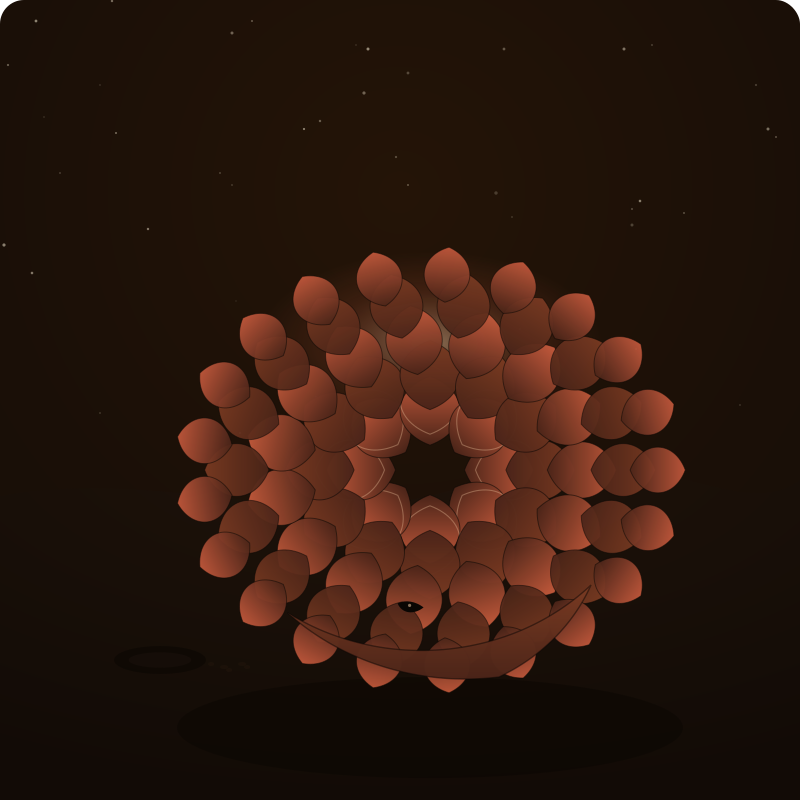
A scaled, toothless mammal of Asia and Africa's forests and savannas, built entirely around one strategy: closing so completely that almost nothing can get through.
Everything this reading says about you is grounded in what the Pangolin actually is: a mammal wearing true keratin armor, a creature with no teeth at all that gets by on a tongue whose sheath runs back toward its own pelvis, and an animal whose main defense is simply becoming a shape most predators cannot open. This chapter is that foundation. The rest of the page draws its meaning from these real traits.
The armor was never the problem. Forgetting there's a door in it is.
6 traits below
01of six
The scale
The Pangolin's entire back, tail, and outer limbs are covered in overlapping keratin scales, the same structural protein that makes up human hair and fingernails.
You are made of the same material as everyone else, arranged into something they can't get past. Your protection was never a separate thing bolted on, it grew out of you.
02of six
The curl
When threatened, the Pangolin rolls into a tight ball, tucking its head and unarmored belly inward while the sharp, overlapping scale edges face outward, a ball most predators cannot open, though big cats still take some.
You do not negotiate with a threat and you do not run from one. Something in you closes instead, the way a Pangolin curls into a shape with no opening, and you simply wait for the danger to lose interest.
03of six
The soft underside
Unlike its scaled back, the Pangolin's belly, face, and inner limbs carry only sparse hair and no scales at all, the one part of its body the curl exists specifically to hide.
Somewhere in you there is a part that was never armored, and you have built your entire posture around making sure no one finds it by accident.
04of six
The tongue with no teeth
The Pangolin has no teeth of any kind; it feeds instead with an extremely long, sticky tongue, over 40 centimetres in larger species, anchored not near the jaw but to a long extension of the breastbone that runs back toward the pelvis.
What actually feeds you runs deeper than what shows at the surface. You reach for what you need from somewhere most people never think to look.
05of six
The scales worth killing for
The Pangolin is widely cited as the most trafficked wild mammal in the world, hunted heavily for scales used in some traditional medicine despite being made of the same keratin as a fingernail, with no proven medicinal effect.
The very thing that protects you is the thing people decide they're entitled to take from you, as if the armor itself were the treasure and not just the shape that kept you alive.
06of six
The nose that finds what the eye can't
With weak eyesight, the Pangolin instead navigates, forages, and locates buried ant and termite nests almost entirely by smell; ground pangolins dig their own burrows, and most species live a largely solitary, nocturnal life.
You don't need to see a thing coming to know it's there. You have a sense for what's true that doesn't depend on being shown proof.