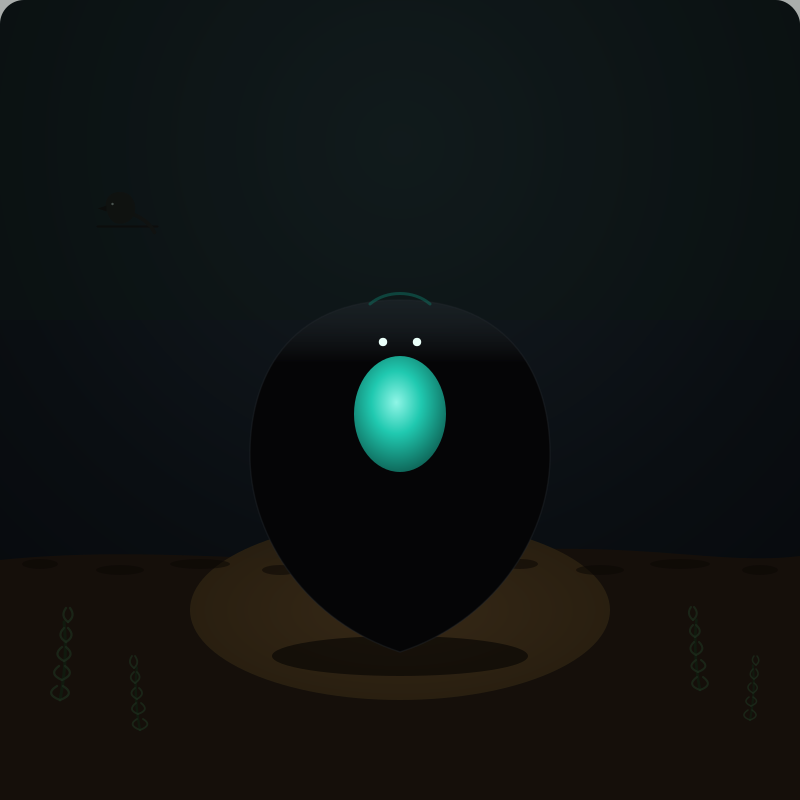
Meet the Superb Bird of Paradise
An ordinary forest bird that turns, for a few exact seconds, into something too perfectly shaped to look real.
A bird of New Guinea's mid- and upper-montane forest, dark-feathered and easy to overlook most of the year, that turns, for a few practiced seconds each breeding season, into one of the strangest shapes any animal produces on purpose.
Everything this reading says about you is grounded in what the Superb Bird of Paradise actually is: a quiet forager for most of its life, a solitary architect of one small, deliberately cleared stage, and the owner of feathers built, at the microscopic level, to erase almost all the light that hits them. This chapter is that foundation. The rest of the page draws its meaning from these real traits.
The shape was never a disguise. It was the one time all season you agreed to be completely seen.
6 traits below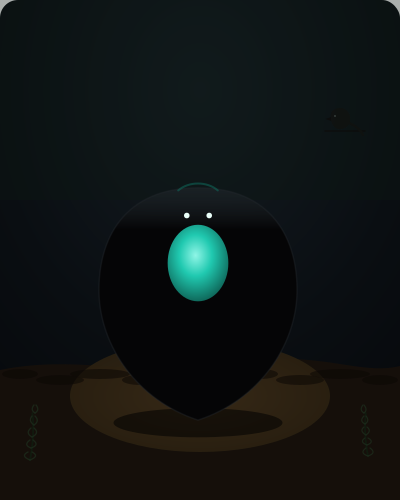
01of six
The cape that eats the light
The male's erectile courtship cape feathers are structurally "super black," their microscopic barbules built from tightly packed, upward-angled filaments that trap incoming light in deep cavities and reabsorb it rather than reflect it, absorbing as much as 99.95 percent of light that strikes them, among the darkest black measured in any bird.
Composure works differently for you: it doesn't just decline to reflect what's happening underneath. It actively swallows the light, so whatever is underneath stays genuinely unreadable, not merely quiet.
02of six
The shield that only shows in contrast
The male carries a separate patch of ordinary black feathers on the back that plays no part in courtship, while the true super-black plumage is reserved specifically for the display cape, worn directly around an iridescent blue-green breast shield he raises only during the display itself.
The one bright thing you actually show is never left out carelessly. It is surrounded on purpose, set beside something dark enough that it cannot be missed once it finally appears.
03of six
The shape with no edges left
At peak display intensity the male fans the cape into a smooth, nearly flat oval wrapped around his whole body while raising the breast shield forward, producing an almost perfectly two-dimensional silhouette that researchers have repeatedly described as resembling a simplified, smiling face, unlike the bird's ordinary three-dimensional shape at any other time.
Briefly, you become capable of something with no loose parts left showing: one clean, deliberate outline instead of a hundred small tells. It is not who you are all the time. It is who you become when it actually counts.
04of six
The rehearsed hop
During peak display the male performs a rapid, precise side-to-side hopping sequence directly in front of the female while holding the fanned shape, a fast, controlled routine entirely distinct from his ordinary, unhurried movement through the forest understory.
There is a version of you that moves with total, rehearsed precision, for exactly one audience, that has nothing in common with how you move through an ordinary day.
05of six
The cleared court
Males are solitary outside of breeding encounters, and each one maintains one or more small display courts, patches of forest floor actively cleared of leaf litter and debris and defended from rivals, returning to the same site across breeding seasons.
A stage stays ready that most people never see you prepare. Its readiness is not for show. It is the actual work, done alone, long before anyone is invited to look.
06of six
The species named by its dance
The superb bird-of-paradise was only formally split from its close relative, the Vogelkop lophorina, in a 2017 to 2018 taxonomic revision, based specifically on measurable differences in the fanned display's shape, one reads as a "smiling" oval, the other a "frowning" crescent, and in its motor pattern, rather than on plumage or song alone.
What actually identifies you, in the end, is not your everyday appearance. It's the exact form the performance takes when you finally give it.